Which LED Strip Dimmer Switch Works? TRIAC, ELV, 0-10V, DALI and DMX Compared
The wall dimmer never dims the strip directly. It talks to the driver or controller, and the two have to speak the same language. Here is how to pick the method that fits the job.
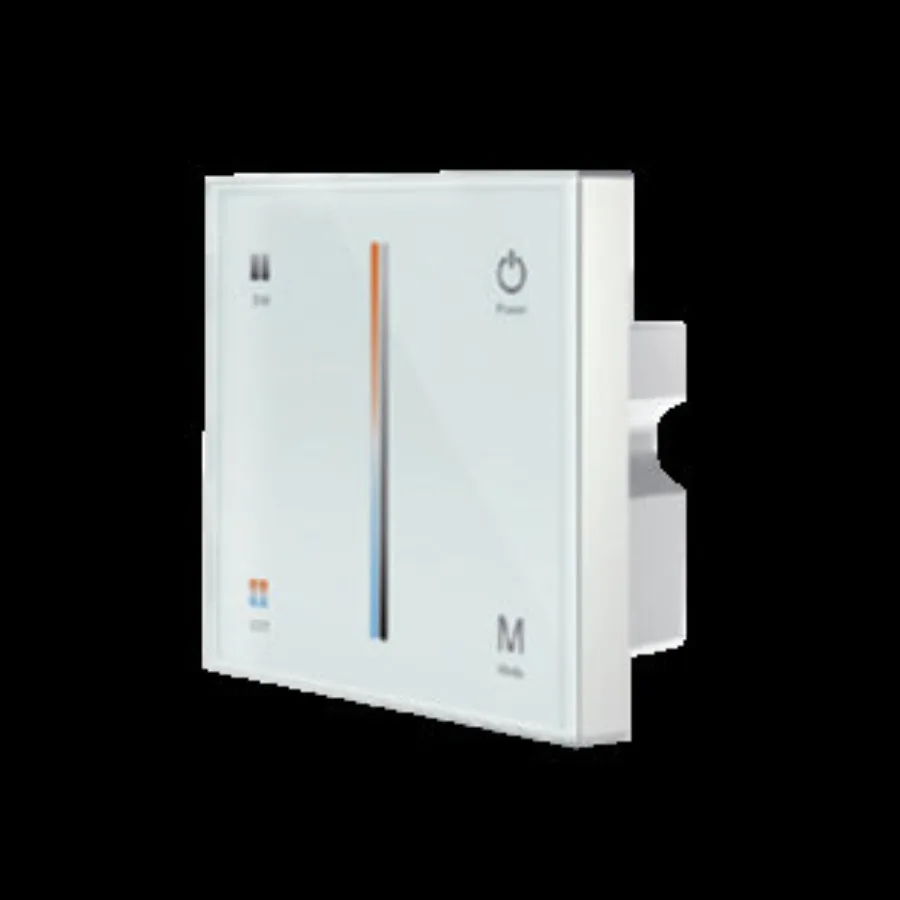
The right LED strip dimmer switch is whichever one uses the same dimming method as your driver or controller. That is the whole rule. A 12V or 24V strip is never dimmed by the wall dimmer directly: the dimmer sends a signal (a chopped AC waveform, a 0-10V voltage, a digital command or a radio message), the driver or controller reads it, and the driver or controller changes the power going to the strip. Pick a TRIAC wall dimmer for a TRIAC dimmable driver, a 0-10V dimmer for a 0-10V driver, a DALI control for a DALI driver. Mix them and you get flicker, buzzing, a strip that only turns on and off, or nothing at all.
Why the Dimmer and the Driver Must Match
A plain constant-voltage driver takes 120V AC in and puts out a steady 12V or 24V DC. It has no idea what a dimmer is. Put a phase dimmer in front of it and the driver sees a mangled sine wave it was never designed to handle. Some drivers shut down, some flicker, some survive for a few months and then fail.
A dimmable driver is built to read one specific kind of signal. Its spec sheet will say which: "TRIAC / forward phase," "ELV / reverse phase," "0-10V," "DALI," or some combination. The dimmer you specify has to be on the same line of that spec sheet.
On the low-voltage side, a wireless receiver, DMX decoder or PWM dimmer sits between a plain driver and the strip and does the dimming itself.
The dimming and control guide covers the signal types in more depth. Here we focus on choosing between them.
Phase Dimming: Forward (TRIAC) and Reverse (ELV)
Phase dimmers chop part of the 120V AC waveform. They need no extra wires, which is their whole appeal.
Forward phase (TRIAC)
Forward phase, also called leading-edge or TRIAC dimming, is the method behind the ordinary incandescent wall dimmer. It cuts the front of each half of the sine wave.
To dim LED strip this way you need a TRIAC dimmable driver (for most interior strip work, a TRIAC dimmable LED driver at 24V) and a wall dimmer that the driver maker lists as compatible.
- Wiring: two line-voltage conductors to the driver (switched hot and neutral), like any light fixture. No extra control wires.
- Strength: it reuses the existing wall box and the existing switch leg. That makes it the default for renovations.
- Weakness: the low end. Many TRIAC setups dim smoothly down to 10% or so and then flicker, pop or drop out. Some buzz. Results depend on the exact dimmer and driver pair.
Reverse phase (ELV)
Reverse phase, also called trailing-edge or ELV (electronic low voltage) dimming, cuts the back of each half wave instead. It was developed for electronic halogen transformers and tends to suit electronic LED drivers better: quieter, and often smoother at the bottom of the range.
- Wiring: same as TRIAC at the driver. Many ELV dimmers need a neutral in the wall box, which older homes don't always have.
- Where it fits: residential and light commercial jobs where you want better low-end performance without pulling control wires.
- Watch for: drivers that accept only one phase type. A driver listed for forward phase won't necessarily behave on an ELV dimmer, and the reverse is also true. Some drivers accept both; the spec sheet says so if they do.
If you are choosing between the two for a new phase-dimmed circuit, an ELV dimmer on a driver listed for reverse phase is usually the better pairing for an ELV dimmer and LED strip.
Control-Wire Dimming: 0-10V and DALI
Both methods add low-voltage control wiring alongside the line-voltage feed, so they belong to new construction or jobs where walls are open.
0-10V
0-10V adds a separate low-voltage control pair (usually violet and gray in the US) between the wall dimmer and the driver. Around 10V on that pair means full output; as the voltage falls, the driver dims. Line voltage still feeds the driver on its own conductors.
- Wiring: line voltage to the driver plus one twisted pair for control.
- Strength: smooth, predictable dimming and lots of drivers on one control. It is the standard in commercial work, and electricians know it well.
- Weakness: 0-10V doesn't switch the light off by itself. At the bottom of the range most drivers sit at their minimum level, not dark. The dimmer needs a built-in switch or relay that cuts line power, or the light never goes fully off.
- Code note: the control pair is typically a Class 2 circuit. If it shares a box or raceway with line-voltage conductors, there are separation and insulation rules. Confirm with your electrician and the local inspector.
For terminals, wire colors and how many drivers one dimmer can run, see how to wire LED strip to a 0-10V dimmer.
DALI, including DT8 for tunable white
DALI (Digital Addressable Lighting Interface) is a two-wire digital bus. Every driver on the bus has an address, so one pair of wires can dim fixtures individually, in groups or in scenes, and drivers can report status back.
- Wiring: line voltage plus a two-wire bus, typically not polarity sensitive. The bus needs its own power supply, and there are limits on how many devices and how much wire one bus can carry. Check the controller documentation for the numbers.
- Strength: flexible after installation. Regroup fixtures, change scenes, add a keypad, all without rewiring.
- Weakness: commissioning. Someone has to address the drivers and program the system, and that takes time and software.
DALI defines device types. Ordinary dimming uses the LED device type; DT8 adds color control, which is how a DALI system handles tunable white strip. With a DT8 driver, one address controls both brightness and color temperature, and the controller sends a Kelvin value rather than juggling two channels. If tunable white is on a DALI job, confirm DT8 support on both the driver and the controls before ordering.
DMX and Art-Net for Color and Effects
DMX512 comes from stage lighting. One DMX "universe" carries 512 channels, each with 256 levels. A single-color strip zone uses one channel, an RGB zone three, an RGBW zone four. The controller sends levels down a daisy-chained data line to DMX decoders, and each decoder drives a section of strip from its own DC driver.
- Wiring: a shielded twisted-pair data run, daisy-chained from decoder to decoder, terminated at the end of the line. Line voltage goes to the DC drivers separately.
- Strength: fast, precise control of many zones and colors.
- Weakness: overkill for "dim the kitchen," and it needs someone to program it.
Addressable strip takes this further: every pixel gets its own channels, so one universe covers 170 RGB pixels (170 × 3 = 510 channels). Big facades and media walls run out of universes quickly, which is where Art-Net comes in. It carries many DMX universes over a regular Ethernet network to nodes near the strip.
Wireless Controllers and PWM Receivers
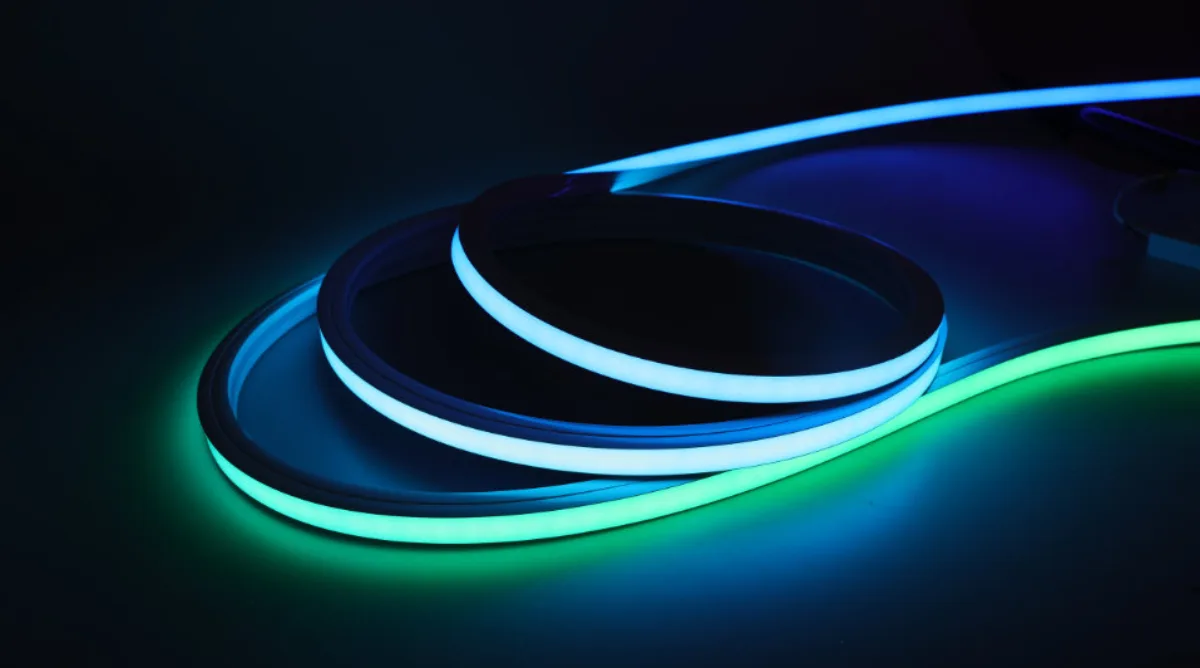
The most common way to dim strip in residential millwork isn't a wall dimmer at all. A PWM receiver (also called a PWM dimmer or LED controller) sits on the DC side between a plain constant-voltage driver and the strip. It switches the DC on and off very fast; the longer the "on" portion, the brighter the strip. A remote, a battery wall panel or an app tells it what to do over radio.
- Wiring: none beyond the DC run. That is the appeal: a cabinet, a closet or a cove can get dimming with no new wires in the wall.
- Strength: cheap, simple, handles tunable white and RGB with multi-channel receivers. Several remotes or panels can pair to one receiver.
- Weakness: the driver stays energized all the time (standby power), radio range and interference vary, and PWM frequency matters. A low frequency can show up as flicker on phone cameras. Check the receiver's PWM frequency on its spec sheet.
The controllers category groups receivers, panels and remotes by channel count.
Decision Table: Which Method Fits
| Method | Wires needed | Typical use | Pros | Cons |
|---|---|---|---|---|
| Forward phase (TRIAC) | Switched hot + neutral only | Renovations, replacing an old dimmer | Reuses existing wiring | Weaker low end, possible buzz, pairing sensitive |
| Reverse phase (ELV) | Switched hot + neutral; neutral often needed in the box | Residential, light commercial | Quieter, smoother low end than TRIAC | Needs a driver listed for reverse phase |
| 0-10V | Line voltage + one control pair | Commercial, new construction | Smooth, many drivers per control | Needs a switch or relay to turn off |
| DALI (DT8 for color) | Line voltage + two-wire bus | Offices, hospitality, larger homes | Addressable, scenes, regroup later | Commissioning time and cost |
| DMX / Art-Net | Data cable (Ethernet for Art-Net) + DC power | Color, effects, facades, media walls | Precise control of many channels | Programming required |
| Wireless / PWM receiver | DC only | Cabinets, closets, coves, retrofits | No new wall wiring | Standby power, radio range |
How to Choose for Your Project
Renovation, existing wall box, no control wires. Phase dimming is the practical answer. Check whether the box has a neutral; if it does, an ELV dimmer and a reverse-phase driver is usually the better pair. If the run is in millwork and the wall can't be opened at all, a PWM receiver with a battery wall panel avoids new wires.
New construction. Pull a control pair now. A Class 2 pair to every strip location costs little at rough-in and keeps 0-10V or DALI open. Choose 0-10V for straightforward dimming and DALI when the owner wants scenes, groups or tunable white from a keypad.
Color and effects. Use DMX (or Art-Net for large pixel counts) for anything that changes color across zones or along the strip. A simple RGB cove in a home can stay on a wireless RGB receiver.
Worked example: a kitchen on a TRIAC dimmer
You are lighting 22 ft of under-cabinet strip. The spec sheet lists 4.4 W/ft at 24V (use your strip's own figure).
- Strip load: 22 ft × 4.4 W/ft = 96.8 W.
- Driver size: 96.8 W ÷ 0.8 = 121 W. A 120 W driver is just short, so step up to 150 W. The power supply calculator does this rounding for you.
- Load on the dimmer: the dimmer sees the driver's input, not the strip. At roughly 90% driver efficiency, that is about 96.8 ÷ 0.9 = 108 W, or about 0.9 A at 120V.
- Check the dimmer rating. Compare 108 W with the dimmer's LED rating, not its incandescent rating. The LED number is usually far lower, and some driver makers ask you to derate further.
- Check the minimum load. Now say the same circuit only fed a 4 ft shelf: 4 × 4.4 = 17.6 W of strip, about 20 W at the driver input. That can fall below a phase dimmer's minimum, which shows up as flicker or a light that won't turn on.
Compatibility Lists, Minimum Load and Multi-Location Control
Compatibility lists. Phase dimming is the method where pairings matter most. Driver makers test their drivers with specific dimmers and publish the results. Use a dimmer from that list, or at least test the exact pair on the bench before rough-in. Our dimmable drivers list the dimming method each one accepts.
Minimum load. Phase dimmers need a minimum load to work properly. One small driver on a big dimmer is a classic cause of flicker. Fixes: combine drivers on one dimmer, pick a dimmer with an adjustable low end, or switch to 0-10V or a PWM receiver for small loads.
Multi-location dimming. For phase dimmers, use the dimmer maker's own companion or remote stations from the same product family; a second dimmer from another brand on a 3-way circuit is a common failure. With 0-10V, use a control system designed for multiple stations rather than paralleling ordinary dimmers. DALI and wireless handle this naturally: add another keypad on the bus or pair another remote.
Common Mistakes
- Putting a wall dimmer in front of a non-dimmable driver. The driver may run, flicker or fail. If the driver doesn't list a dimming method, it isn't dimmable.
- Dimming the DC side with a line-voltage dimmer. A wall dimmer goes on 120V AC to a driver that accepts it. It never goes between the driver and the strip.
- Mixing phase types. A forward-phase-only driver on an ELV dimmer, or the reverse.
- Forgetting the off switch on 0-10V. The strip glows faintly at minimum instead of turning off.
- Ignoring minimum load. A 20 W load on a dimmer that wants more.
- Running 0-10V or DALI wire loose with line conductors. Separation and insulation rules apply. Ask your electrician.
- Blaming the strip for flicker. Most low-end flicker comes from the driver and dimmer pairing. Our LED strip flickering guide walks through the diagnosis.
- Choosing the control last. Switching to 0-10V after drywall means opening walls to pull a control pair.
Frequently asked questions
Can I use a regular dimmer switch on LED strip lights?
Only if the strip is powered by a dimmable driver built for that kind of dimmer. A standard incandescent-style dimmer needs a TRIAC (forward-phase) dimmable driver; on a plain driver it will cause flicker or damage.
What is the best dimmer for LED strip lights?
The one that matches your driver. For renovations, an ELV dimmer with a reverse-phase driver usually dims smoothest without new wires; for new construction, 0-10V or DALI gives the most consistent results; for color effects, use DMX.
What is the difference between TRIAC and ELV dimmers for LED strip?
A TRIAC dimmer cuts the leading edge of the AC waveform and an ELV dimmer cuts the trailing edge. ELV usually runs quieter and dims lower with electronic LED drivers, but the driver must be listed for reverse phase.
Do I need a special driver for a 0-10V dimmer?
Yes. The driver must have 0-10V dimming inputs, and you need a separate low-voltage control pair from the dimmer to the driver. The dimmer should also switch line power so the strip turns fully off.
Can a DMX controller dim white LED strip?
Yes. A DMX decoder can dim single-color and tunable white strip, one channel per color. It makes most sense when the project already uses DMX for color or effects.
Specify with ENKORA
Working on a project? Send us the drawings and we will propose strips, profiles and drivers that fit together.