2700K vs 3000K vs 4000K: Choosing a Color Temperature Room by Room
2700K reads like an old incandescent lamp, 3000K like halogen, 4000K like a bright office. Here is where each one belongs, room by room, and how to test before you order.
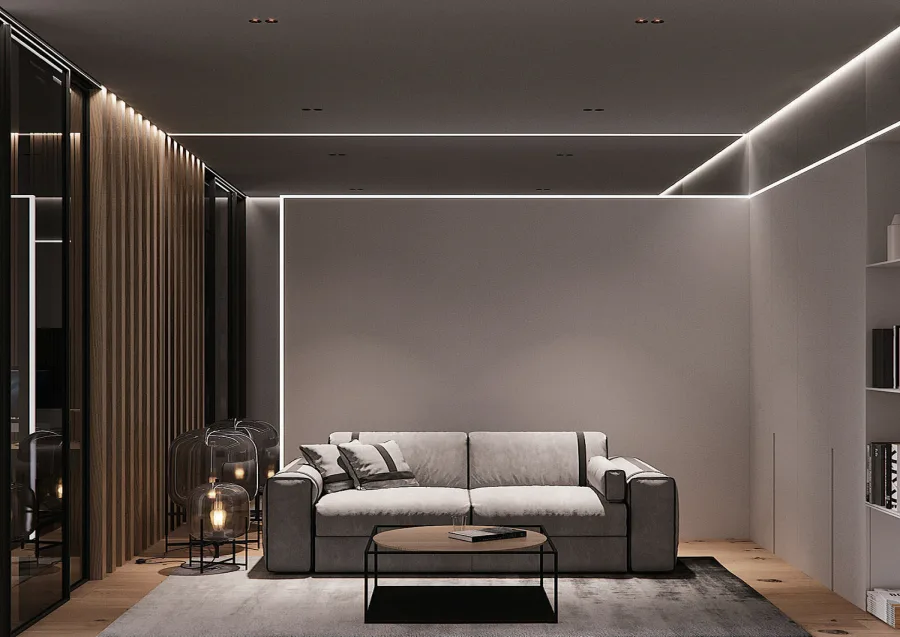
2700K vs 3000K comes down to how warm you want the room to feel: 2700K matches the amber glow of an incandescent bulb and suits living rooms and bedrooms, while 3000K is a slightly crisper warm white that works in kitchens and bathrooms without looking yellow. 4000K is neutral white, clean and businesslike, better for task areas, garages, offices and retail. In most homes the choice is 2700K or 3000K; 4000K earns its place in work spaces.
That's the short answer. The longer one depends on the room, the finishes and what else is lit nearby.
What Kelvin Means in Plain Terms
Color temperature, measured in kelvin (K), describes how warm or cool white light looks. The scale comes from heating a piece of metal: it glows red, then orange, then yellow-white, then bluish white as it gets hotter. Lower numbers are warmer and more amber, higher numbers are cooler and bluer.
The counterintuitive part: "warm" light has the lower number.
2700K reads like an incandescent lamp because a household incandescent filament really does run at around that temperature. Generations of people grew up with that color in their homes, so 2700K reads as "home at night." Halogen ran a little hotter, closer to 3000K, which is why 3000K feels warm but slightly cleaner. Daylight sits around 5000K to 6500K depending on the sky.
The color temperature guide covers how CCT is measured and how it relates to the light source itself.
The Common CCTs at a Glance
| CCT | How it looks | Typical use |
|---|---|---|
| 2200K / 2400K | Deep amber, candlelight | Bars, restaurants, accent and mood lighting, dimmed hospitality |
| 2700K | Warm, incandescent | Living rooms, bedrooms, dining, coves |
| 3000K | Warm white, halogen-like | Kitchens, bathrooms, hallways, hospitality, high-end retail |
| 3500K | Between warm and neutral | Mixed-use spaces, offices that want warmth, some retail |
| 4000K | Neutral white | Offices, garages, workshops, task lighting, retail |
| 5000K | Cool white, daylight-like | Workshops, inspection areas, some commercial |
| 6500K | Cold, bluish daylight | Display and specialty uses; rarely right in homes |
All of these are available in static white strip; which ones a given strip comes in varies by product, so check the CCT options on each product page.
Room by Room
Living room and bedroom. 2700K is the safe default. Coves, shelves and headboard lighting are about atmosphere, not task work. Go to 2400K or 2200K if the strip is purely accent and the owner likes a candlelit look.
Kitchen. This is where 3000K vs 4000K comes up most. Ambient and cove lighting in an open kitchen usually wants 3000K so it blends with the living area. Under-cabinet task lighting can go either way: 3000K keeps everything warm and cohesive; 4000K makes counters look brighter and cleaner, and suits white, modern kitchens. The rule that matters more than the number: under-cabinet, cove and toe-kick runs in the same kitchen should all use the same CCT. Our under-cabinet lighting guide covers placement and output.
Bathroom and vanity. 3000K for most homes. It's flattering to skin and reads clean on tile. For grooming and makeup, pair it with high CRI; 3500K to 4000K is an option for owners who want the mirror to look closer to daylight. In 3000K vs 4000K bathroom debates, the deciding factor is usually the rest of the house: a 4000K bathroom off a 2700K bedroom will look stark at night.
Home office. 3500K to 4000K helps with reading and screen work. If the office doubles as a guest room or den, consider tunable white.
Closet. 3000K to 3500K with high CRI, so clothing colors read true. Black and navy are easier to tell apart under good color rendering than under a cooler CCT.
Garage, laundry and utility. 4000K to 5000K. These are work spaces, and neutral to cool light makes detail easier to see.
Retail. It depends on the merchandise. Warm 3000K flatters wood, leather and food; 3500K to 4000K suits apparel and general merchandise; jewelry and some electronics displays go cooler.
Restaurant and bar. 2200K to 2700K for dining rooms and bars, often dimmed. Back-of-house and kitchens run 4000K for work.
Office. 3500K to 4000K is the norm for general lighting. Lobbies and break rooms may go warmer.
Healthcare and galleries. Both care more about color rendering than about any single CCT. Exam and treatment areas often use neutral light with high CRI so skin tones read accurately; galleries pick CCT to suit the work and the curator. Follow the facility's own standards and the designer's spec.

Mixing CCTs in One Space
Mixing color temperatures is fine when it's deliberate and the sources don't meet. A 3000K cove over a 2700K seating area looks intentional. A 4000K under-cabinet run that meets a 3000K toe kick at the same cabinet corner looks like a mistake.
Where runs meet or sit side by side, they must match closely, and that means more than the same number on the label. Two strips sold as 3000K can still look different if the tolerance is wide. Tight binning, expressed as SDCM (standard deviation of color matching), keeps reels consistent with each other. The binning and SDCM guide explains what to ask for. On large jobs, order all of one CCT at once so it comes from the same production run.
How Finishes Change the Choice
The surfaces the light lands on matter as much as the number on the spec sheet.
- Warm wood, brass, terracotta, cream plaster. Stay at 2700K or 3000K. Cooler light makes warm wood look gray and dull.
- White stone, white lacquer, white tile. 3000K reads clean; 4000K reads crisp and modern. Either can work. Avoid 2700K if the owner wants the white to look white rather than ivory.
- Cool gray, concrete, stainless, blue-gray paint. 3500K to 4000K. Very warm light on cool gray can look muddy.
- Mixed palettes. Light for the dominant surface the strip actually hits, like the backsplash under a cabinet or the ceiling in a cove.
CCT, CRI and Output
CCT tells you the color of the light. CRI tells you how accurately that light shows the colors of the things it lands on. They are separate, and a 2700K strip with poor color rendering looks worse than a well-rendered 3000K one. For kitchens, bathrooms, closets and retail, look for CRI 90 or higher; the CRI guide explains the numbers, including R9 for reds.
Output also shifts with CCT. Warmer versions of the same strip are often slightly less efficient, because the phosphor that warms the light costs some output. The difference varies by product and is usually modest.
Worked example
Say a spec sheet lists 420 lm/ft at 4000K and 380 lm/ft at 2700K for the same strip (illustrative figures; use the real ones from the product page). Over a 12 ft cove:
- 4000K: 12 × 420 = 5,040 lm
- 2700K: 12 × 380 = 4,560 lm
- Difference: 480 lm, about 9.5%
A 10% change in output is hard to notice in a room, especially on a dimmed cove. Pick the CCT that suits the space, then check that the output still meets your target. If the warmer version falls short for a task application, a higher-output strip in the same CCT is usually a better fix than going cooler.
Tunable White and Dim-to-Warm
When a room changes use, a fixed CCT is a compromise. Two alternatives:
- [Tunable white](/collections/tunable-white). The strip carries warm and cool LEDs, and a controller blends them anywhere across its range (the range varies by product). A home office can run neutral during the day and warm at night; a restaurant can shift from lunch to dinner service.
- Dim-to-warm. The light gets warmer as it dims, the way an incandescent lamp did. Full brightness might be around 3000K and the lowest levels near candlelight. It needs no extra controls beyond a dimmer, which makes it simple for dining rooms and hospitality.
Both need the right controller or driver; plan the controls when you pick the strip.
How to Test Before Ordering
Swatches on a screen are useless for judging CCT. Test with the real thing:
- Get samples of the two CCTs you're deciding between, from the same product line you intend to use.
- Power them with a real driver at the voltage the strip needs. A battery tester won't show true output.
- Hold them against the actual surfaces: the backsplash tile, the cabinet finish, the stone slab, the paint.
- Look at night, with the room's other lights on as they will be in use. Daylight hides the difference between 2700K and 3000K.
- Put them in a channel with the intended diffuser. A diffuser can shift the look slightly.
- Check the adjacent lighting. Compare against the downlights and lamps already in the room. A strip that disagrees with the downlights is the most common complaint after install.
Common Mistakes
- Choosing 4000K or 5000K for a living space because "it looks brighter." It does, and it also looks like an office at 9 p.m.
- Mixing CCTs on runs that meet. Under-cabinet, toe kick and cove in one kitchen should match.
- Ordering the same CCT from different sources or batches. Same label, visibly different color.
- Ignoring the downlights. A 3000K strip under 2700K recessed cans looks off, and so does the reverse.
- Judging samples in daylight or on a phone screen. Test at night, on the real surfaces.
- Treating CCT as a substitute for CRI. A warm, low-CRI strip still makes wood and skin look flat.
- Going too warm on white stone. 2700K turns white quartz ivory.
Frequently asked questions
Is 3000K or 4000K better for a kitchen?
3000K suits most home kitchens, especially open plans that connect to living areas. 4000K works for white, modern kitchens or when under-cabinet task light is the priority. Use the same CCT for every strip run in the kitchen.
Is 2700K too yellow?
Not for living rooms, bedrooms and dining rooms, where it matches the incandescent light people associate with home. It can look too yellow on white stone or in a kitchen, where 3000K usually reads cleaner.
What is the difference between 2700K and 3000K?
2700K is warmer and more amber, like an incandescent bulb; 3000K is slightly whiter, closer to halogen. Side by side the difference is clear, but in a room on its own either reads as warm white.
Is 3000K or 4000K better for a bathroom?
3000K for most homes, since it flatters skin and matches the rest of the house at night. 3500K to 4000K with high CRI is a good choice at a vanity used for makeup or grooming.
What is the best color temperature for LED strip lights?
For most homes, 2700K in living areas and bedrooms and 3000K in kitchens and bathrooms. Work spaces like garages, offices and workshops use 4000K, and tunable white covers rooms that change use.
Specify with ENKORA
Working on a project? Send us the drawings and we will propose strips, profiles and drivers that fit together.