Under-Cabinet LED Strip Lighting: Placement, Profiles and Power for Kitchens
Where the strip sits under the cabinet matters more than which strip it is. A practical guide for kitchens and millwork.
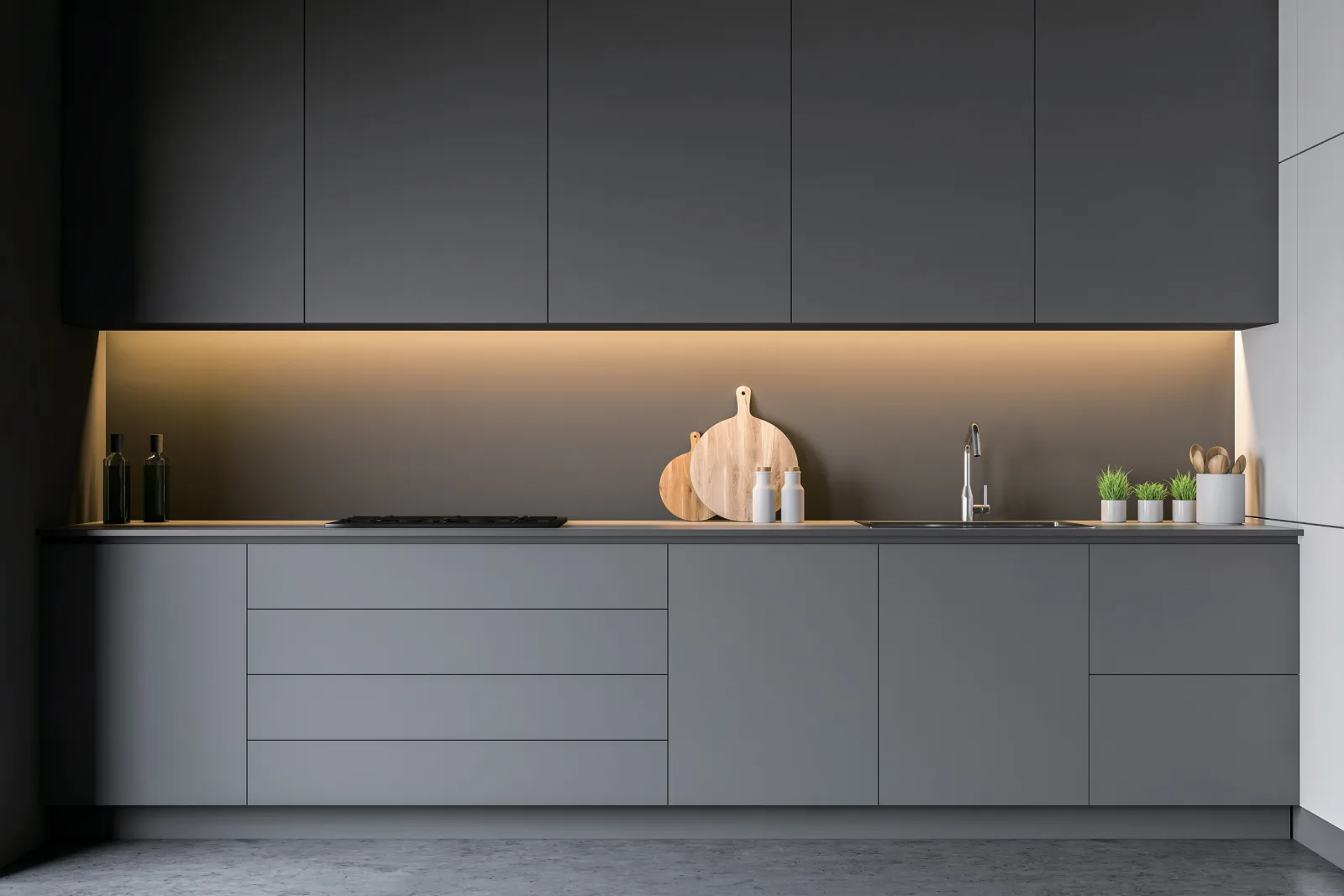
Under-cabinet LED strip lighting has two jobs. It puts task light on the counter, and after dark it draws a clean line that shapes the whole kitchen. A strip that does the first job well but throws a row of hot spots across a polished quartz counter has failed at the second. Almost all of the difference comes down to placement and the profile, not the strip itself.
Where to Mount the Strip
Mount the strip toward the front of the cabinet underside, usually 1–2 in. behind the face frame or light rail. Light then spreads across the counter and up the backsplash instead of dropping straight onto the counter edge, where it glares into the eyes of anyone sitting at the island.
Mounting at the back, tight to the backsplash, grazes the wall and picks out tile texture. On handmade tile or textured stone that can look great. It also leaves the front of the counter in shadow, so treat it as a deliberate effect and still light the work surface properly.
Use a Profile and a Diffuser
Glossy counters reflect every LED as its own little dot. A shallow aluminum profile with a frosted or opal diffuser turns that into one continuous line, and the aluminum pulls heat away from the strip at the same time.
- Surface-mount profiles suit most cabinets and need no routing.
- Recessed profiles sit flush in a routed groove and all but disappear. Plan them before the cabinets are built, not after.
- Corner (45°) profiles aim the light at the backsplash and the counter at once.
No room for a diffuser? Use a COB strip. Its dense chip layout reads as a continuous line even in a reflection. Our cabinetry and millwork collection gathers strips suited to this work, and very shallow reveals call for tape from the NARROW series.
Color Temperature and CRI
- 3000K is the most common choice for kitchens. It feels residential and still reads crisp for food prep.
- 2700K suits kitchens that open onto warmly lit living spaces.
- 3500–4000K fits contemporary white kitchens and commercial prep areas.
Whatever you pick, match the kitchen's other lights. And specify CRI 90+ as a minimum, since food, wood and stone look noticeably better under it. Go to CRI 95+ where finishes are being shown to clients.
How Bright Should It Be?
For counter task light, 300–500 lm/ft works for most cabinets hung about 18 in. above the counter. Lower output is fine when the lighting is purely for mood.
Because the strip sits so close to eye level, dimming matters more than raw output. Specify a dimmable driver, and the same strip gives bright task light during dinner prep and a soft glow at night.
Power, Switching and Dimming
- Choose 24V for anything beyond one short cabinet.
- Put the driver somewhere accessible and ventilated: above the cabinets, inside a neighboring cabinet or in a nearby utility space. Never seal it behind finished panels.
- Home-run each cabinet section back to the driver instead of daisy-chaining long distances across the kitchen.
- Size the driver at run length × W/ft ÷ 0.8. The power supply calculator does the math.
- Choose the control early: a wall dimmer matched to the driver type, 0–10V or DALI in commercial kitchens, or a wireless controller. See dimming and control.
Near the Sink and the Cooktop
A strip near the sink sees splashes and cleaning spray, so use an IP65 build or a sealed profile there. Keep strips and connections away from the heat and steam over the cooktop. That's a job for the range hood light. The IP ratings guide has the details.
Common Under-Cabinet Mistakes
- Mounting at the back "to hide it." The strip is hidden, but the counter is dark exactly where people work.
- No diffuser over a glossy counter. Every LED shows up twice: once in the strip and once in the stone.
- Mixing color temperatures. 4000K under the cabinets and 2700K in the pendants makes both look wrong.
- Forgetting the gap at the end panel. Leave a little room for the end cap and the cable exit, or the last inch of profile won't close.
Frequently asked questions
Where should under-cabinet LED strips be placed?
Toward the front of the cabinet underside, typically 1–2 inches behind the face frame. That spreads light across the counter and backsplash and avoids glare for people seated at an island.
What color temperature is best for under-cabinet lighting?
3000K is the most common choice for residential kitchens. Use 2700K if the adjoining living spaces are lit warm, and 3500–4000K for contemporary white kitchens or commercial prep areas. Match the room's other light sources.
How do I stop LED dots showing on a glossy countertop?
Use an aluminum profile with a frosted or opal diffuser, or choose a COB strip, whose dense chip layout reads as a continuous line even when reflected.
Do under-cabinet LED strips near a sink need to be waterproof?
Use an IP65 build or a sealed profile near sinks, where splashes and cleaning spray reach the fixture. Dry cabinets away from water can use IP20.
Specify with ENKORA
Working on a project? Send us the drawings and we will propose strips, profiles and drivers that fit together.