What Is an LED? How Light-Emitting Diodes Work, Types, Specs and Lifespan
What actually happens inside an LED, why white light starts out blue, and which numbers on a spec sheet are worth your attention.
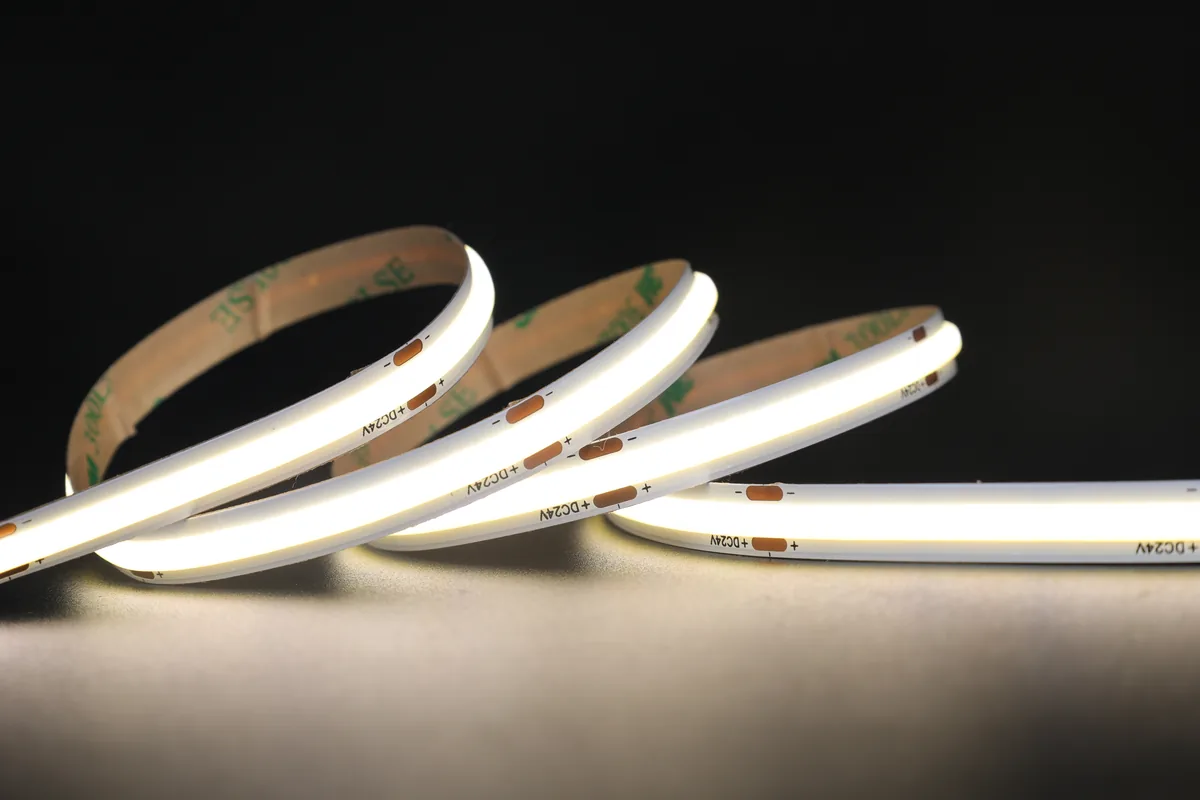
What is an LED? It's a light-emitting diode: a small semiconductor chip that gives off light when current runs through it in one direction. That's the whole trick. There's no filament to burn out and no gas to excite, which is why LEDs last so long, turn on instantly and waste far less energy as heat than the lamps they replaced.
If you specify or install lighting, it pays to know a little more than that. Most of the questions we get from contractors ("why does this strip need a driver?", "why is the far end dimmer?", "why doesn't 3000K from two brands match?") make sense once you know what's going on inside the chip.
How an LED Makes Light
A diode is built from two layers of semiconductor. One layer has extra electrons; the other has "holes," places where electrons are missing. Where the two layers meet, a junction forms.
Apply voltage in the right direction and electrons cross the junction and drop into the holes. Each time that happens, the electron gives up a small packet of energy. In an LED, the materials are chosen so that energy leaves as a photon — light.
The color of that light depends on the semiconductor. Different materials release different amounts of energy per electron, and energy sets wavelength:
- indium gallium nitride (InGaN) produces blue and green;
- aluminum gallium indium phosphide (AlGaInP) produces red, orange and amber.
Two practical consequences follow. First, an LED only works one way round, so polarity matters on every connection. Second, each color needs a certain minimum voltage before it lights at all, roughly 1.8–2.2 V for red and 2.8–3.3 V for blue and white.
Where White Light Comes From
There's no such thing as a white LED chip. Almost every white LED you'll buy is a blue chip under a phosphor coating. The phosphor absorbs part of the blue light and re-emits it as yellow, green and red. Mix what gets through with what the phosphor adds and you see white.
The phosphor recipe is where a lot of quality is won or lost. It decides:
- the color temperature (warm 2700K or cool 5000K);
- the color rendering (how natural skin, wood and food look);
- how consistent one reel is with the next.
That's why two strips labeled 3000K can still look different side by side. The label is a target; the phosphor mix and the binning tolerance decide how close each batch lands. More on that in our guide to binning and SDCM.
A Short History
LEDs aren't new. The first practical visible-light LED, a dim red one, was demonstrated by Nick Holonyak Jr. at General Electric in 1962. For decades after, LEDs meant indicator lights: the red power dot on a stereo, the green glow of a calculator.
The breakthrough came in the early 1990s, when Isamu Akasaki, Hiroshi Amano and Shuji Nakamura made bright, efficient blue LEDs from gallium nitride. Blue was the missing piece. Add phosphor and you get white; add red and green and you get full color. The three shared the 2014 Nobel Prize in Physics for it, and within twenty years LEDs went from novelty to the default light source in American homes and buildings.
Why an LED Needs a Driver
An LED's current rises steeply with a small rise in voltage. Feed one straight from a battery or the wall and it runs away, overheats and fails. Something has to hold the current in check.
In LED strip, that's handled in two places:
- On the strip. LEDs are wired in short series groups with a resistor or a small constant-current chip. A 24V strip typically groups more LEDs per segment than a 12V one, which is why cut points sit farther apart on 24V tape.
- At the power supply. The driver converts line voltage (120V AC in most US homes) to the low-voltage DC the strip expects, usually 12V or 24V.
Get the driver wrong and nothing else matters. Size it with headroom (total watts ÷ 0.8) using the power supply calculator, and see powering LED strips for the details.
Types of LEDs You'll Run Into
| Type | What it is | Where you see it |
|---|---|---|
| Through-hole (5 mm) | The classic domed LED with two legs | Indicators, signs, older products |
| SMD | A flat package soldered onto the board's surface | Most LED strip, panels, bulbs |
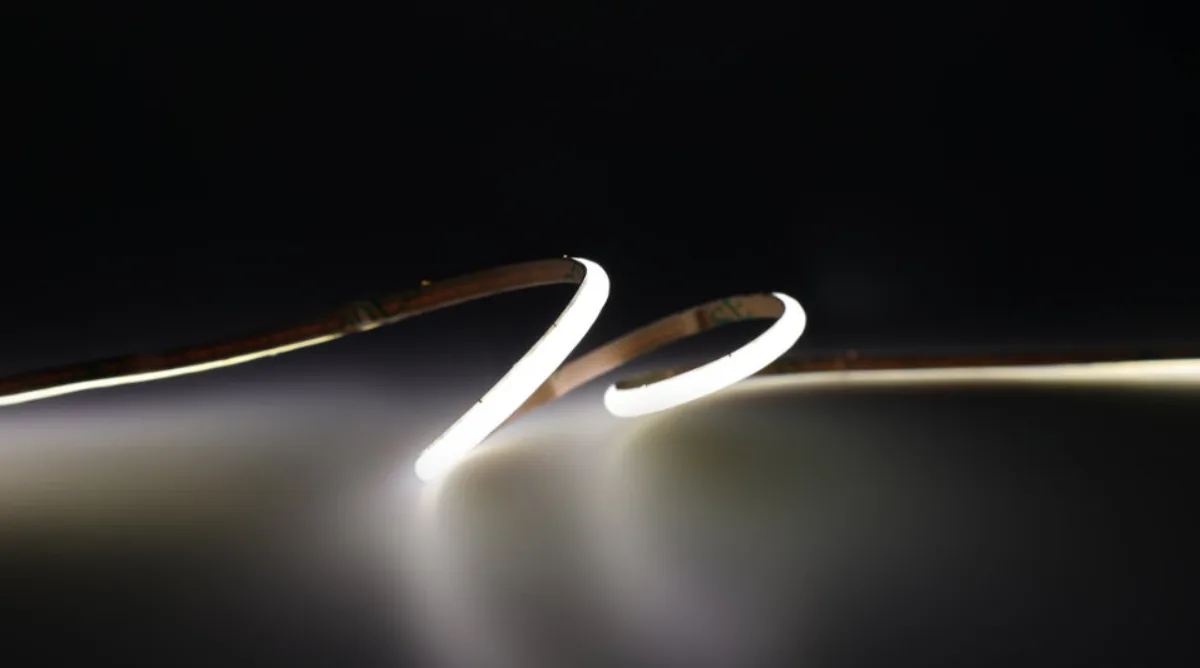
| COB (chip-on-board) | Many tiny bare chips under one continuous phosphor line | Dotless strip, downlights, spotlights |
| High-power | A single large chip on a heavy thermal pad | Floodlights, streetlights, stage lighting |
| OLED and micro-LED | Organic or microscopic emitters | Mostly phone, TV and display screens |
In strip lighting, the choice that matters is SMD vs COB.
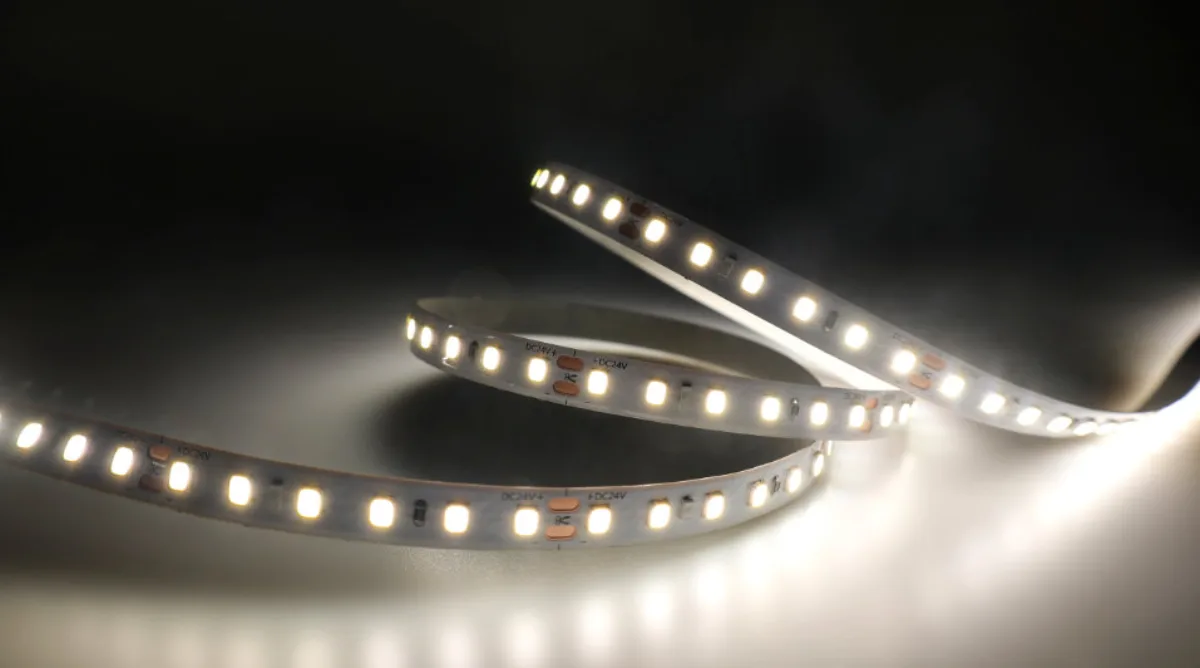
SMD packages are named for their size in millimeters. A 2835 measures 2.8 × 3.5 mm (about 0.11 × 0.14 in.) and is the workhorse of white strip. A 5050 is 5 × 5 mm (about 0.2 in. square) and often holds three chips, which makes it a common choice for RGB.
COB strip places chips so densely under a single strip of phosphor that the light reads as a continuous line, even with no diffuser. SMD strip shows its individual dots unless it sits in a profile. The COB vs SMD guide goes deeper.
How to Read an LED Spec Sheet
A spec sheet can look like alphabet soup. These are the lines worth reading carefully.
| Spec | What it tells you | What good looks like |
|---|---|---|
| Lumens (lm, lm/ft) | Total light output; for strip, per foot | Depends on the job: 150–250 lm/ft for accent, 300–500 for task |
| Efficacy (lm/W) | Light per watt of power | Higher means less energy, smaller drivers, less heat |
| CCT (K) | Warmth or coolness of white | 2700–3000K homes, 3500–4000K offices and retail |
| CRI (Ra) and R9 | How accurately colors look | CRI 90+ for interiors; ask for R9 on premium jobs |
| SDCM | Color consistency between LEDs | 3-step or tighter for runs that sit side by side |
| Beam angle | How widely light spreads | Around 120° is typical for strip |
| L70 / L90 life | Hours until output falls to 70% or 90% | Ask how it was measured and at what temperature |
Two of these deserve a note.
Lifespan isn't a failure date. LEDs rarely die suddenly; they fade. An "L70 of 50,000 hours" means output is projected to fall to 70% of the original after 50,000 hours. In the US those projections come from standardized testing: IES LM-80 measures output over time, and TM-21 is the method for projecting it forward. A lifetime figure without a test temperature is a marketing number.
CRI can hide red. The headline CRI averages eight pastel test colors and leaves out R9, saturated red. A light can score CRI 90 and still make skin and wood look flat. Our CRI guide explains why.
LEDs vs Incandescent, Halogen and Fluorescent
| Incandescent | Halogen | Fluorescent | LED | |
|---|---|---|---|---|
| Typical efficacy | 10–17 lm/W | 12–24 lm/W | 50–100 lm/W | 80–160+ lm/W |
| Typical life | 750–1,000 hrs | 2,000–4,000 hrs | 8,000–30,000 hrs | 25,000–50,000+ hrs (L70) |
| Warm-up | Instant | Instant | Slow in the cold | Instant |
| Mercury | No | No | Yes | No |
| Dimming | Easy | Easy | Limited | Yes, with a compatible driver |
Beyond the numbers, LEDs are small and directional. That's what makes linear lighting possible at all: a strip a quarter of an inch wide can hide in a cabinet reveal, a stair nosing or a ceiling cove where no lamp would ever fit. And because white LEDs put out virtually no ultraviolet or infrared in the beam, they're gentle on artwork, fabrics and food displays.
What Shortens an LED's Life
LEDs are tough, but they have one real enemy: heat. A chip that runs hot loses output, shifts color and fades years early. The usual culprits:
- No heat sink. Strip stuck straight onto wood or drywall has nowhere to shed heat. An aluminum profile acts as a heat sink as well as a diffuser mount.
- Overdriving. Running a strip above its rated voltage, or on a driver with no headroom.
- The wrong environment. Moisture on an indoor-rated strip, or any standard strip in a sauna. Match the IP rating to the location, as covered in the IP ratings guide.
- Poor connections. A loose or cold-soldered joint heats up under load and fails first.
Troubleshooting: Common LED Strip Problems
| Symptom | Likely cause | What to check |
|---|---|---|
| Far end dimmer or warmer than the start | Voltage drop | Run length, feed wire gauge; add a second feed |
| Flicker when dimmed | Driver and dimmer mismatch | Dimmer type vs driver type; minimum load |
| One section dark | Damaged cut point or joint | The connection at the start of the dark section |
| Nothing lights | Polarity or no output | + and − reversed; driver output voltage |
| Color differs between runs | Mixed batches or voltage drop | Order codes and batch numbers; measure voltage at each end |
For long runs specifically, our article on voltage drop walks through the math.
Looking Ahead
LED efficacy keeps climbing, so the same light costs less energy each year. The bigger shifts for lighting designers are in quality rather than quantity: higher color rendering as standard, tunable white that follows the time of day, and tighter color consistency from batch to batch. For strip lighting, that means fewer compromises between a warm, flattering light and an energy code.
Frequently asked questions
What does LED stand for?
LED stands for light-emitting diode: a semiconductor that emits light when current flows through it in the forward direction.
How long do LED lights last?
Quality LED products are typically rated for 25,000 to 50,000 hours or more to L70, the point where output falls to 70% of the original. Heat is the main factor: the same LED lasts much longer when it runs cool.
Why do LED strips need a power supply?
LEDs need a controlled, low DC voltage. The driver converts 120V AC household power to the 12V or 24V DC the strip is designed for, and holds it steady.
Are LEDs better than incandescent bulbs?
For almost every use, yes. LEDs use roughly 75–90% less energy for the same light, last many times longer, turn on instantly and contain no mercury.
What is the difference between SMD and COB LEDs?
SMD LEDs are individual packages spaced along a board, so they can show as dots without a diffuser. COB LEDs pack many small chips under one continuous phosphor line, so the light reads as a smooth, unbroken line.
Specify with ENKORA
Working on a project? Send us the drawings and we will propose strips, profiles and drivers that fit together.