Tunable White LED Strip: Wiring, Controllers and Where It Pays Off
How two-channel tunable white strip is wired, which control system to pair it with, how to size the driver, and where a fixed CCT is the simpler answer.
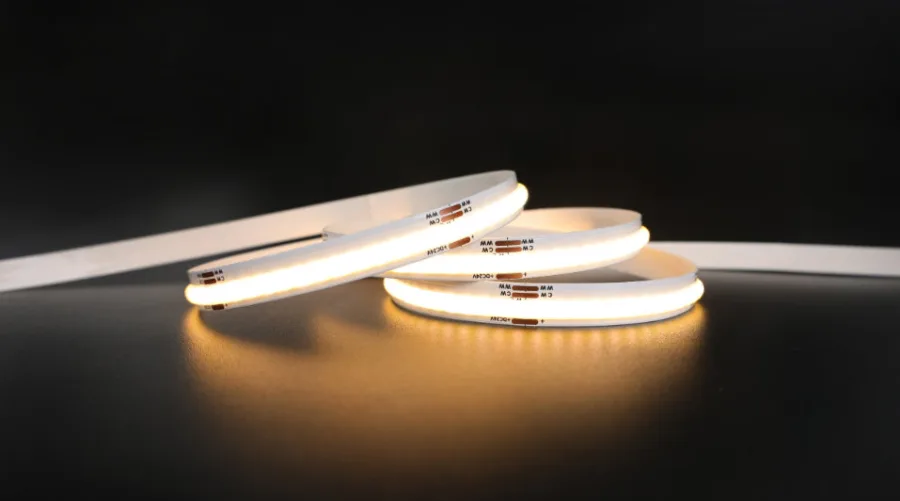
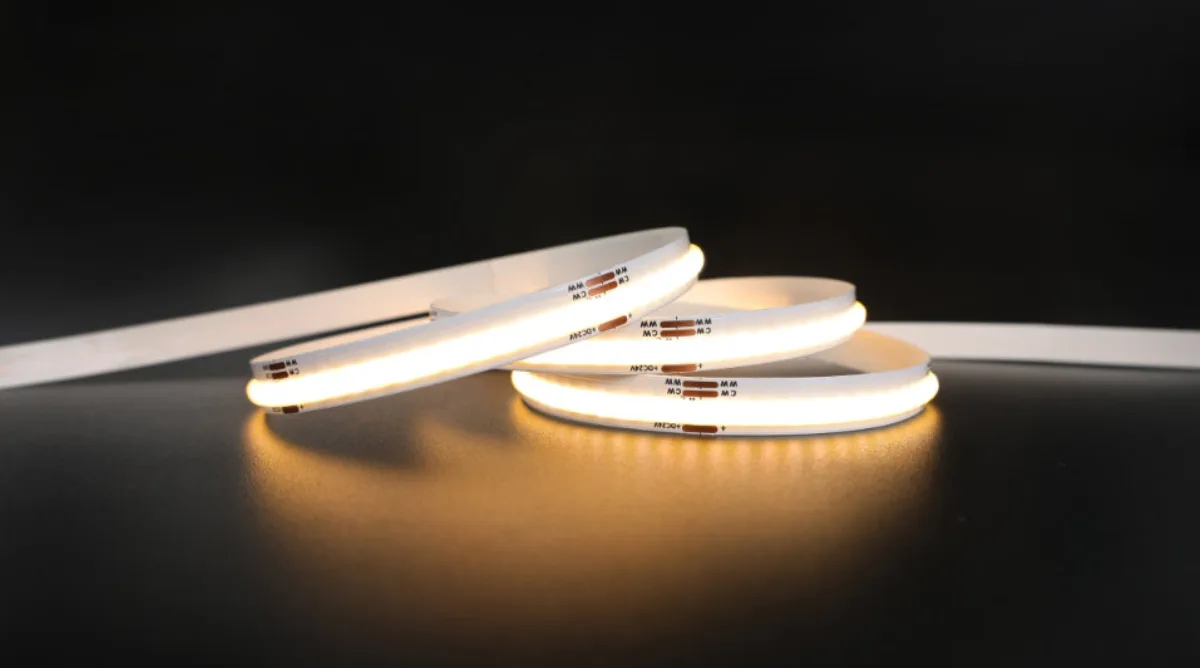
A tunable white LED strip carries two sets of white LEDs, one warm and one cool, and mixes them so you can set the color temperature anywhere between the two, separately from brightness. That makes it a two-channel product. It needs a third conductor in the run, a controller that drives both channels, and a driver sized for both at full. Get those three things right at rough-in and the rest is commissioning.
Get them wrong and you find out after the drywall is closed. This guide covers how tunable white works, how to wire it, which control systems fit which jobs, how to size the driver, and where a fixed color temperature or dim-to-warm is the better call.
How Tunable White Works
Every tunable white strip has two channels:
- a warm white channel, typically around 2700K, sometimes lower;
- a cool white channel, typically somewhere from 5000K to 6500K.
The exact end points depend on the product, so check the spec sheet. The controller dims each channel independently, usually with PWM (switching each channel on and off very fast). Turn up the warm channel and turn down the cool one and the mix moves warmer. Balance them and you land in the middle, around 4000K.
For the user, that becomes two separate controls: brightness (both channels up or down together) and color temperature (the balance between them). That's the difference from ordinary dimming, and it's why the system needs more than a standard dimmer.
Two practical points follow. First, you can't tune past the end points. If the warm channel is 2700K, the strip will never reach 2200K. Second, at either end only one channel is lit, so output at 2700K or 6500K is lower than the strip's combined figure. Check lumens per foot at the end points, not just the headline number.
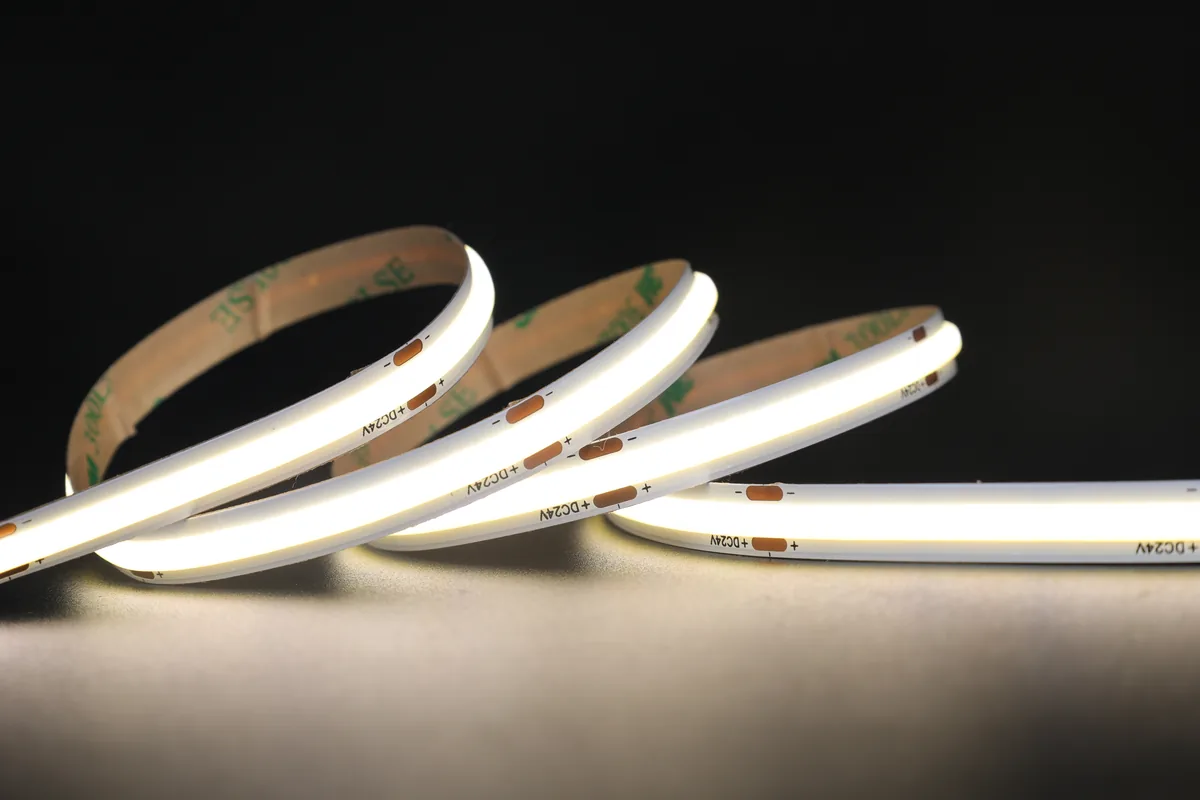
On many SMD tunable strips, warm and cool packages alternate along the board, so give the light a diffuser and some distance to blend. COB tunable strips mix the two under a continuous phosphor line and read as one color even up close. Browse the tunable white collection for both types.
Wiring: Three Conductors, All the Way
Most tunable white strip is wired with three conductors:
- V+, a common positive shared by both channels;
- WW−, the warm white negative;
- CW−, the cool white negative.
The controller sits between the driver and the strip. The driver's positive passes through to the strip's V+, and the controller switches the two negatives. That's the typical layout, but pad order and markings vary, so check the strip's pinout before you solder or clip on a connector.
Rules that hold on every job:
- Carry all three conductors to every feed point. A long run fed from both ends, or from the middle, needs both channels at each feed, not just power.
- Keep the color code consistent from controller to strip. Pick one color for warm and one for cool and use it everywhere. A swapped pair makes one section go cool while the next goes warm.
- Size the common for the total current. V+ carries the current of both channels together, so treat it as carrying the full load.
- Use connectors made for three conductors. A two-pin connector forced onto a tunable strip drops a channel.
- Use low-voltage cable that the inspector will accept for the location, especially inside walls and ceilings. Confirm with the local inspector or a licensed electrician.
Control Options
There are five common ways to drive a tunable white strip. The right one depends on what the rest of the building runs.
| Control system | What you need | Good for |
|---|---|---|
| Dedicated CCT controller + CV driver | A constant-voltage 12V or 24V driver and a two-channel CCT controller, usually with an RF remote or wall panel | Homes, single rooms, millwork, retrofits |
| Two-channel 0-10V | Two 0-10V dimmable drivers (one per channel) or one CV driver plus a two-channel 0-10V decoder, and controls that send two 0-10V signals | Commercial jobs already wired for 0-10V |
| DALI DT8 | A DALI DT8 (Device Type 8) driver or decoder that accepts color temperature commands, a DALI bus and someone to commission it | Offices, schools, healthcare, buildings with a lighting control system and schedules |
| DMX | A DMX decoder with two channels per zone, a DMX controller or console, and a properly terminated data line | Hospitality, venues and entertainment spaces already on DMX |
| Wireless or smart receivers | A receiver (RF, Zigbee, Bluetooth or Wi-Fi, depending on the system) between driver and strip, plus a remote, panel or app from the same system | Homes and retrofits with no control wire in the wall |
A few notes on the table. With 0-10V, the two signals are either warm level and cool level, or brightness and color temperature, depending on the decoder. Check which, because it changes what the wall control does. DALI DT8 handles brightness and color temperature on a single address, which is why it's popular on larger commercial jobs. DMX is flexible but needs addressing and a programmed console.
Whatever you choose, check the controller's per-channel current rating against the strip. Our controllers category lists CCT controllers and receivers, and the dimming and control guide explains each protocol in more depth.
Sizing the Driver: A Worked Example
The rated watts per foot on a tunable strip's spec sheet is usually the maximum with both channels at full. Some sheets list power per channel instead, so read the note. Size the driver for the maximum, because someone will eventually run both channels at 100%. The rule is the same as any strip: length × W/ft ÷ 0.8.
Example: under-cabinet lighting in a kitchen, 16 ft of 24V tunable white strip, with a spec sheet listing 4.4 W/ft (an example figure; use the one on your strip's sheet).
- Load: 16 ft × 4.4 W/ft = 70.4 W.
- Driver: 70.4 W ÷ 0.8 = 88 W, so a 96 W driver.
- Total current: 70.4 W ÷ 24V = 2.93 A. All of it flows through the common positive.
- Per channel: about 1.47 A each with both channels at full, if the strip splits its load evenly. Check the spec sheet.
- Controller: per-channel rating above 1.47 A, total rating above 2.93 A.
- Feed cable: the driver sits 15 ft away, on 18 AWG copper (6.385 Ω per 1,000 ft). Treating the full 2.93 A as flowing both ways gives a conservative drop of 2 × 15 ft × 2.93 A × 0.006385 Ω/ft = 0.56V, about 2.3% of 24V. That's acceptable.
Now double the run to 32 ft. The load becomes 140.8 W, the driver works out to 176 W (a 200 W unit), and total current rises to 5.87 A. At that point it's usually cleaner to split the run into two zones of 16 ft, each with its own 96 W driver, and link them with a CCT amplifier (a repeater that copies the controller's output to a second driver) or a controller that handles both zones. Smaller supplies also make it easier to stay with Class 2 power sources, which are limited to 100 VA; check that each driver is labeled Class 2. Confirm the arrangement with the electrician of record.
Where Tunable White Pays Off
Tunable white earns its extra conductor in rooms that change job during the day.
- Kitchens that become dining rooms. Crisp, cooler white for prep and cleanup, warm 2700K for dinner, from the same under-cabinet and cove runs.
- Offices used into the evening. A cooler, brighter setting through the working day and a warmer one for late meetings or after-hours use.
- Hospitality. A restaurant cove that serves breakfast and then a late bar. A hotel room where guests set their own mood.
- Healthcare, senior living and schools. Owners often want the color temperature to follow a daytime schedule, cooler at midday and warmer in the evening, so the space changes feel through the day. DALI DT8 or a scheduled control system handles this.
If the client also wants saturated color on the same line, look at RGB+CCT strip, which adds red, green and blue to the two white channels. It needs five channels and six conductors, so plan for it from the start.
When Fixed CCT or Dim-to-Warm Is Simpler
Tunable white is not the default. Plenty of rooms are better served by something simpler.
| Option | Channels | What the user controls | Best for |
|---|---|---|---|
| Fixed CCT | One | Brightness only | Rooms that do one job; most coves, closets, stairs |
| Dim-to-warm | Typically one, check the product | Brightness, with CCT following automatically | Homes and restaurants that want an incandescent-style dim |
| Tunable white | Two | Brightness and CCT separately | Rooms that change use through the day |
- Fixed CCT is cheaper, needs a two-wire run and an ordinary dimmer, and at its one color temperature it puts all its LEDs to work.
- Dim-to-warm gets warmer as it dims, the way an incandescent lamp does. The client gets one simple control and the familiar warm glow at low levels. It can't be cool at low output or warm at full output.
- Nobody will use the controls. If no one is going to set scenes or a schedule, the second channel is wasted money.
Our color temperature guide compares tunable white and dim-to-warm side by side.
Color Consistency Across the Range and Between Reels
Tunable white adds two consistency questions that a fixed-CCT strip doesn't have.
Across the range. The end points are each a phosphor white. In-between settings are a mix, and a mix of two whites can sit slightly off the ideal white line at intermediate settings. CRI can also vary across the range. On critical jobs, ask for color data at both ends and the midpoint, not just one CCT.
Between reels. Each channel has its own binning tolerance, so two reels can match at 2700K and drift apart at 5000K. Order a job's strip from one batch, ask for tight binning (3-step SDCM or better for runs that meet), and check joined runs at both ends of the range during commissioning. The binning and SDCM guide explains the numbers.
Controllers matter here too. Different controllers map their sliders differently, so two zones both set to "50%" on different brands can land at different color temperatures. Use one controller model throughout a space.
Common Mistakes
- Two-wire runs that can't carry both channels. The most expensive mistake, because the fix means opening walls. Pull at least three conductors to every tunable location at rough-in. Many installers pull four, so the spare covers a damaged conductor.
- A controller without enough channels. A single-channel dimmer on a tunable strip lights one channel, or both tied together with no tuning at all.
- Ignoring channel current limits. A run that's fine for the driver can still exceed the controller's per-channel rating. Check both, and add an amplifier rather than overloading the controller.
- Mixing brands of controllers and receivers. RF remotes and receivers rarely pair across brands, and even standard protocols behave differently between makers. Pick one system for the project.
- Feeding only power at a mid-feed point. Both channel negatives have to reach every feed, or that section stops tuning.
- Dimming twice. A PWM controller after a driver that is also being dimmed can cause flicker and odd behavior. Let one device do the dimming.
Frequently asked questions
How many wires does tunable white LED strip need?
Usually three: a common positive plus one negative for the warm channel and one for the cool channel. Carry all three to every feed point and through every connector.
What controller do I need for tunable white LED strip?
Any controller that drives two channels: a dedicated CCT controller with a remote or wall panel, a two-channel 0-10V setup, DALI DT8, DMX, or a wireless receiver. Check that its per-channel current rating covers the strip you're running.
What is the difference between tunable white and dim-to-warm?
Tunable white sets color temperature independently of brightness, so a room can be cool at full output or warm at full output. Dim-to-warm ties the two together and gets warmer as it dims, like an incandescent lamp.
How do I size a driver for tunable white strip?
Use the strip's rated watts per foot, which is usually the figure with both channels at full, multiply by the run length and divide by 0.8. For example, 16 ft at 4.4 W/ft is 70.4 W, which calls for a 96 W driver.
Can I use a regular dimmer on tunable white LED strip?
Not for tuning. A single-channel dimmer can only drive one channel, or both tied together, so you lose control of color temperature. You need a controller or control system that handles two channels.
Specify with ENKORA
Working on a project? Send us the drawings and we will propose strips, profiles and drivers that fit together.