LED Shelf Lighting Strip for Retail Displays and Display Cases
Where to put LED strip on retail shelving and display cases, which CRI and color temperature suit which merchandise, how to hide the LEDs and how to wire it through millwork.
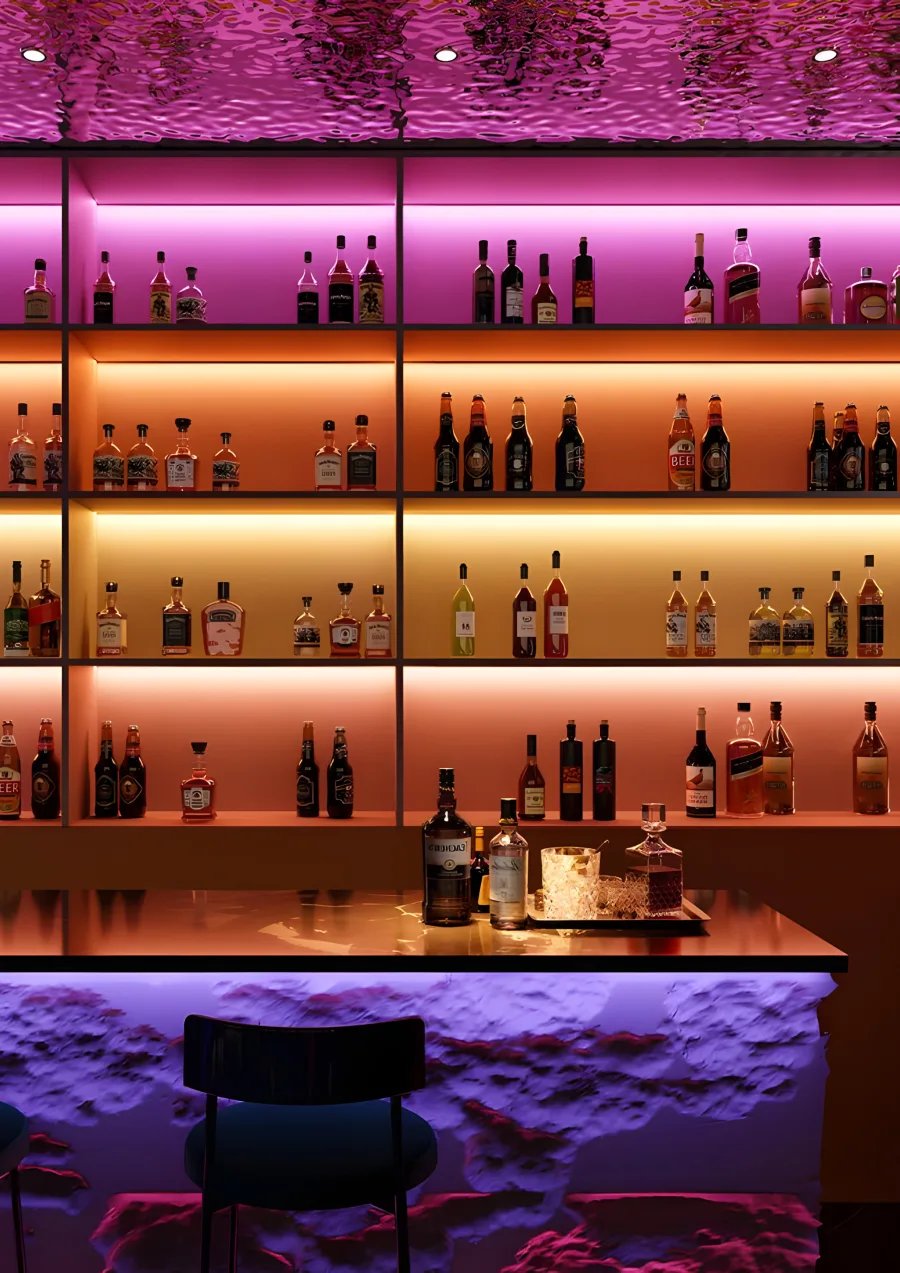
An LED shelf lighting strip works best mounted at the front edge of each shelf, under the shelf above and aimed back toward the merchandise, so light lands on the faces of the products instead of the tops. Add high CRI (90 or better), a color temperature chosen for what's on the shelf, and a channel that hides the LEDs from the shopper's eye, and you have a display that sells instead of one that glares.
This guide covers mounting positions, CRI and color temperature by merchandise, glare control, low-profile channels, glass shelves, wiring through millwork, heat and UV, and a worked example for a 6-shelf case.
Where to Put the Strip: Five Positions
Each position lights a different part of the product. Most good displays use two of them together.
| Position | Effect | Best for |
|---|---|---|
| Front edge of shelf, aimed back | Lights the front faces and labels of products on the shelf below | Packaged goods, bottles, books, cosmetics |
| Under-shelf, centered or toward the rear | Downlight on product tops, pools of light | Folded apparel, shoes, jewelry trays |
| Vertical, in the front corners of a case | Side light that reaches every shelf, adds sparkle and shape | Glass towers, jewelry, watches, collectibles |
| Backlit back panel | Product silhouetted against a glowing panel | Spirits and wine, glassware, trophies |
| Top canopy, aimed down | Lights the top shelf and passes through glass shelves | Glass display cases, counters |
A strip mounted dead center under a shelf lights the tops of products and leaves their fronts in shadow. That's fine for a jewelry tray viewed from above, but for anything a shopper sees face-on, move it to the front.
CRI and Color Temperature by Merchandise
CRI. Retail lighting should be CRI 90 or higher. Shoppers judge freshness, finish and color under your light, and a low-CRI strip makes reds look brown and skin tones look gray. For cosmetics, fresh food and fabric where color is the selling point, CRI 95 with a strong R9 (saturated red) value is worth it. The CRI 90 vs 95 article covers when the step up matters, and the high CRI collection lists strips with their CRI on each product.
Color temperature. The typical guidance by merchandise:
- Bakery, bread and pastry: 2700K to 3000K. Warm light makes crusts look golden.
- Wine, spirits and chocolate: 2700K to 3000K, warm and rich.
- Apparel: 3000K to 3500K. Warm enough to flatter, neutral enough to show true fabric colors.
- Cosmetics: 3000K to 3500K with high CRI, close to the light customers will see themselves in.
- Jewelry with gold: 3000K to 3500K.
- Diamonds, silver, platinum and watches: 4000K or a bit higher, with high CRI. Cooler light brings out sparkle and white metals.
- Electronics and tech: 4000K for a clean, modern look.
Keep one CCT per display or per department. Mixing 2700K and 4000K in one case makes both look wrong.
Glare Control: Light the Product, Not the Shopper
A bare strip at eye level in a case is a row of bright dots aimed at the customer. Control it with the channel and the aim.
- Angled channels. A corner or 45° channel mounted at the front of the shelf aims the strip back toward the products. Shoppers standing in front see the shelf edge, not the LEDs. The corner channels are designed for exactly this inside-corner position.
- Lenses instead of diffusers. A frosted diffuser hides the dots but spreads light everywhere, including toward the shopper. A lens narrows the beam onto the product. The optic channels use a lens for a defined beam.
- Recess or shield. A shallow lip on the front of the shelf, or a channel set back slightly from the edge, cuts the direct view of the strip.
- Check from the customer's position. Stand where shoppers stand, at their eye height, and look at the shelf. If you see the light source, adjust the aim or add shielding.
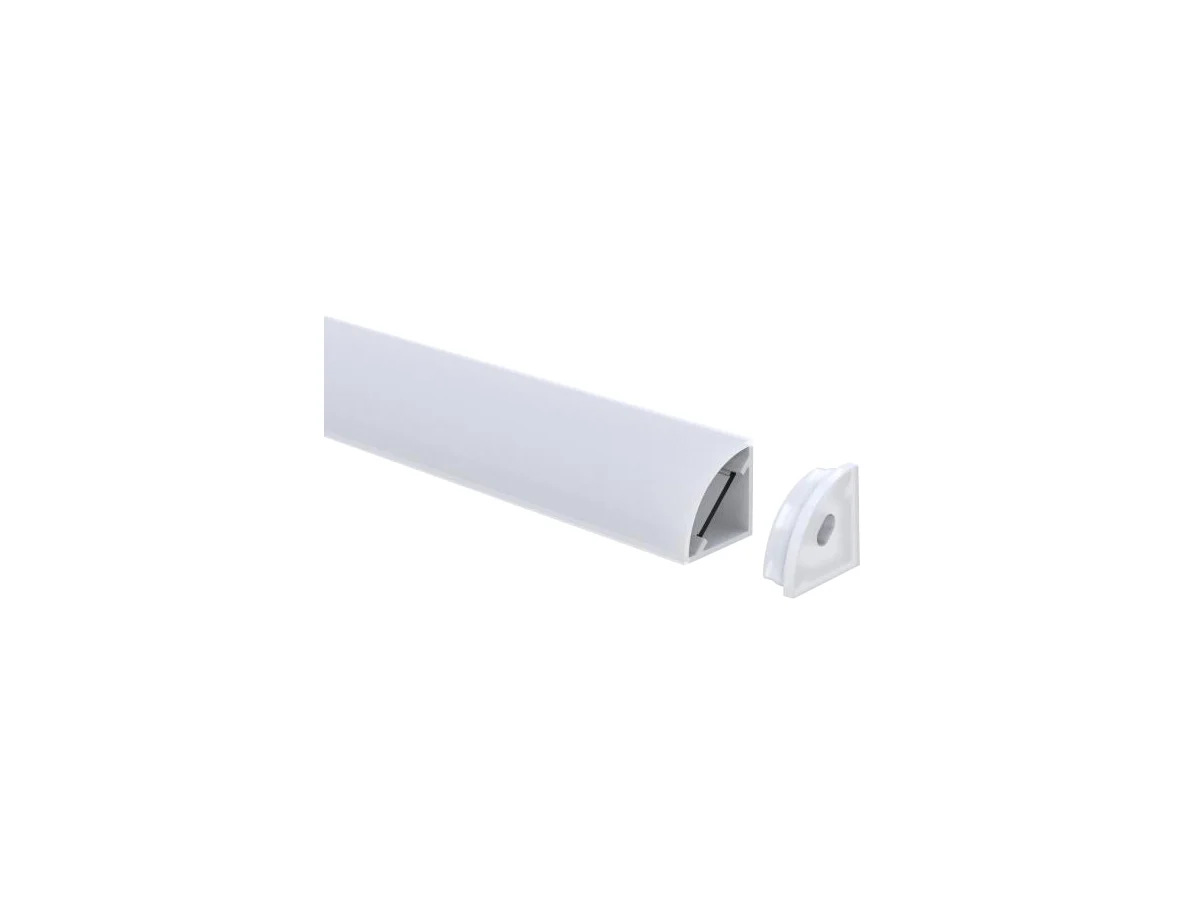
Low-Profile Channels and Narrow Strip
Retail shelves are thin. Many are 3/4 in or less, and glass shelves have no room at all. The channel has to disappear into the edge.
- Ultra-narrow strip fits shallow, slim channels that tuck under a shelf or into a routed groove. See the ultra-narrow collection for strip widths.
- Recessed channels routed into the underside of a wood shelf sit flush and leave a clean line.
- Surface channels on the underside work on metal and laminate shelves you can't route.
Match the channel to the strip width and confirm the fit on the channel's dimension drawing before you order. A channel even slightly too narrow for the strip makes for a frustrating install.
Glass Shelves and Edge Lighting
Glass shelves change the approach. You can't hide a channel inside glass, so the light usually comes from somewhere else.
- Top and bottom lighting. A strip in the case ceiling or base shines through the glass shelves and lights every level. It's simple, but products on upper shelves shade the ones below.
- Vertical corner strips in the front or rear corners of the case light all shelves from the side, and glass doesn't block them.
- Edge lighting. A strip in a slim channel along the edge of the glass pushes light into the glass itself. The polished edges glow, and any etched or frosted pattern lights up. It's a decorative effect more than product lighting. Standard glass often has a green tint at the edge; low-iron glass glows more neutral.
- Clip-on shelf-edge rails hold a strip along the front of a glass shelf and carry power through the rail or a fine wire.
Wiring Through Millwork and Driver Location
Plan the wiring with the millwork shop, before the case is built. Retrofitting wiring into finished casework is slow and leaves visible cable.
- Route feeds inside stiles and back panels. Drill or groove a wire chase up the back corner of the case. Leave pull strings in place.
- Feed each shelf separately from a distribution block or terminal near the driver. Daisy-chaining every shelf in series puts all the current through the first shelf's wire.
- Adjustable shelves need a plug-in connection. Options include powered shelf standards with contact strips, pin-and-socket shelf connectors and coiled leads with quick-disconnects. Pick one before the case is drawn, because it sets the hardware.
- Driver location. Put the driver somewhere accessible and ventilated, often in the base cabinet behind a removable panel or grille. Never seal a driver inside a closed cavity with no airflow and no service access.
- One switch point. Store staff need a simple way to turn displays on and off. Tie case drivers to a wall switch, a lighting control system or a timer.
Line-voltage connections should be done by a licensed electrician to local code.
Heat and UV Around Sensitive Merchandise
LED strip is far gentler on merchandise than halogen or incandescent display lighting, but it isn't zero.
- Heat. The strip itself gets warm, and the heat goes into whatever it's mounted on. An aluminum channel spreads it out. Keep strip off direct contact with chocolate, candles, cosmetics and anything that softens with heat, and favor lower-wattage strip in enclosed cases. The beam itself carries very little infrared, unlike halogen. Our article on whether LED strips get hot explains where the heat goes.
- UV. White LEDs that use a blue chip and a phosphor emit essentially no ultraviolet in their light output. That's one reason LEDs replaced older sources in display cases. Some LEDs use a violet pump instead and put out a little near-UV and violet light. If you're lighting UV-sensitive items like museum textiles, archival paper or certain dyes, ask for the strip's spectral data before you specify it.
- Fading. Any visible light fades sensitive materials over time, LED included. Keep levels moderate and turn displays off after hours.
Worked Example: A 6-Shelf, 4 ft Display Case
Say you're lighting a 4 ft wide, 6-shelf glass-front display case with a 24V CRI 95 strip whose spec sheet lists 3 W/ft. You'll put a strip at the front edge of each shelf and a vertical strip in each front corner.
- Shelf runs: the inside width allows 3.5 ft of strip per shelf at the nearest cut point. 6 shelves × 3.5 ft = 21 ft.
- Corner runs: two vertical strips, each 6 ft tall = 12 ft.
- Load: shelves 21 × 3 = 63 W; corners 12 × 3 = 36 W; total 99 W.
- Drivers: one driver for everything would need 99 ÷ 0.8 = 124 W, which is more than one Class 2 output can supply. Split it instead: shelves 63 ÷ 0.8 = 79 W, so a 96 W Class 2 driver; corners 36 ÷ 0.8 = 45 W, so a 60 W driver. Two zones also let you dim the corners and shelves separately.
- Current: shelf zone 63 ÷ 24 = 2.63 A; corner zone 36 ÷ 24 = 1.5 A.
Now the wiring. The drivers sit in the base cabinet. The shelf zone runs 6 ft of 18 AWG up to a distribution block, then a separate lead to each shelf.
- Main feed: 2 × 6 ft × 2.63 A × 0.006385 Ω/ft = 0.20 V, or 0.8% of 24V.
- Each shelf lead: one shelf draws 10.5 W, or 0.44 A. On 22 AWG at up to 7 ft that's 0.10 V, or 0.4%.
- Corner zone: 1.5 A on 8 ft of 18 AWG drops 0.15 V, or 0.6%.
Every drop is under 1%, so the light will match from the top shelf to the bottom. Size your own case with the power supply calculator and check the strip's maximum run on its spec sheet.
Common Mistakes
- Strip centered under the shelf. It lights product tops and leaves the faces dark. Move it to the front edge and aim it back.
- Visible LED dots. A bare strip on a glossy shelf reflects as a row of dots. Use a channel with a diffuser or lens.
- Low CRI on food or cosmetics. Colors look off and products look stale. Go 90 minimum, 95 where color sells.
- Mixed color temperatures between cases or shelves in the same department.
- Daisy-chained shelves. The bottom shelf gets less voltage and looks dimmer. Feed each shelf from a distribution point.
- Driver sealed in the millwork. It overheats and can't be serviced. Leave access and ventilation.
- No plan for adjustable shelves. If shelves move, the wiring has to move with them. Decide on plug-in connections before the case is built.
Frequently asked questions
Where should LED strip go on a shelf?
For products seen face-on, mount the strip at the front edge of the shelf above, on the underside, and aim it back toward the merchandise. A strip centered under the shelf lights product tops and leaves the fronts in shadow.
What color temperature is best for retail display lighting?
Typical choices are 2700K to 3000K for bakery, wine and chocolate, 3000K to 3500K for apparel, cosmetics and gold jewelry, and 4000K for diamonds, silver, watches and electronics. Keep one color temperature per display.
What CRI do I need for display case lighting?
Use CRI 90 or higher for retail displays. For cosmetics, fresh food and fabrics where color is the selling point, CRI 95 with a strong R9 value is worth the step up.
How do you light glass shelves with LED strip?
Light glass shelves from the case top and base, from vertical strips in the case corners, or with clip-on rails along the shelf front. Edge lighting a glass shelf makes its edges and any etching glow but is more decorative than product lighting.
Do LED strip lights damage merchandise with UV or heat?
White LEDs that use a blue chip and phosphor emit essentially no UV, and their beam carries very little heat compared with halogen. The strip itself gets warm, so keep it off heat-sensitive products and ask for spectral data when lighting UV-sensitive items.
Specify with ENKORA
Working on a project? Send us the drawings and we will propose strips, profiles and drivers that fit together.