LED Lighting for Pools and Water Features: What IP68 Does and Doesn't Mean
An IP68 rating is where a pool specification starts, not where it ends. Here's what else has to be true before light goes underwater.
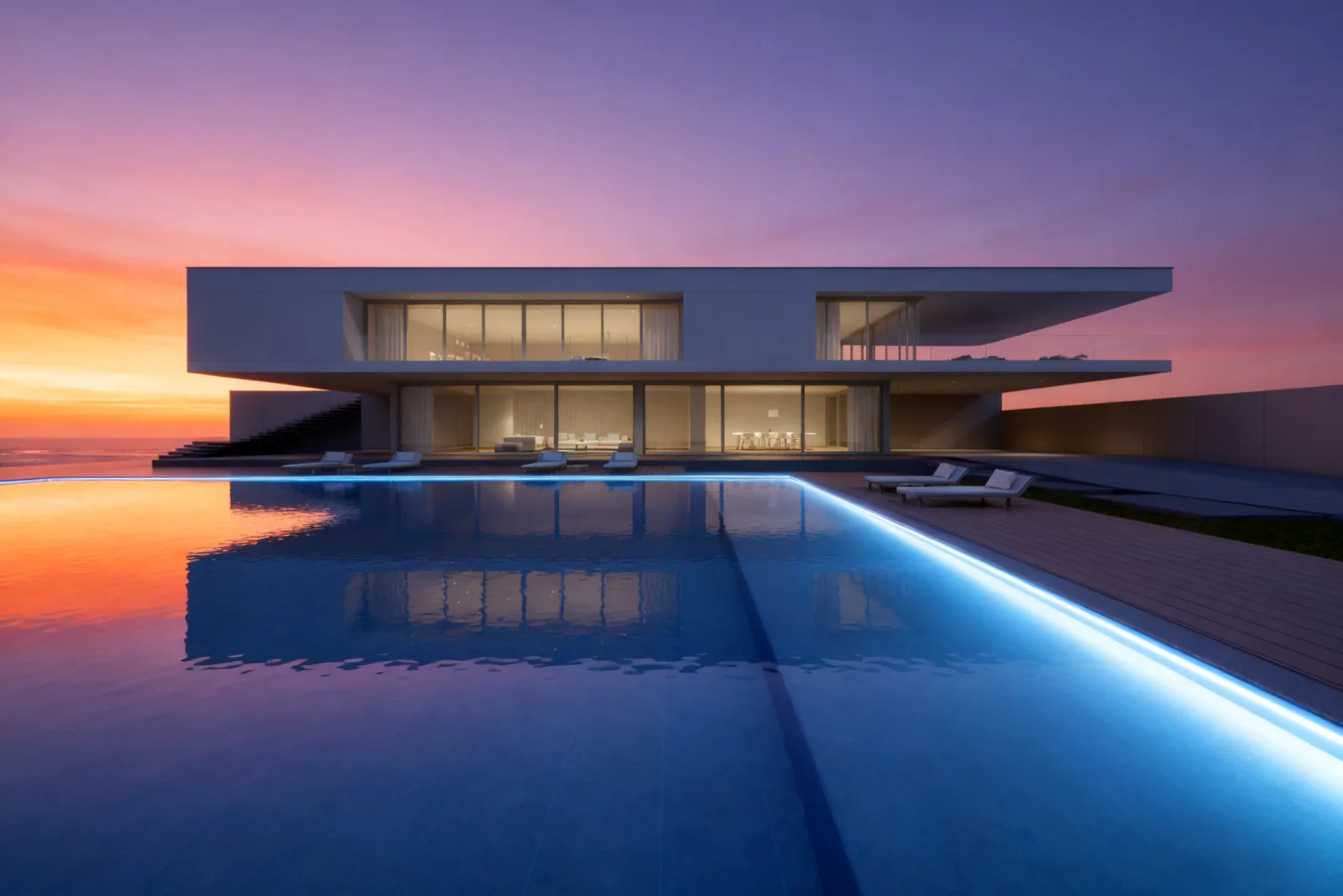
LED strip lights for pools, spas and fountains produce some of the most striking effects in outdoor lighting. They're also where a wrong specification costs the most. Water, chemicals, heat and electrical safety rules all apply at once, and fixing a failed run means draining, digging or cutting stone.
This guide covers what to check before you specify. It doesn't replace the electrical code or your local inspector, and it isn't meant to.
IP67 and IP68 Are Different Promises
The IP code (IEC 60529) rates protection against solids and water:
- IP67: protected against temporary immersion, tested at 1 m for 30 minutes.
- IP68: protected against continuous immersion under conditions the manufacturer specifies, which must be more severe than IP67.
IP68 tells you the product kept water out during a test. It doesn't tell you how the product holds up after years in chlorinated or salt water, in direct sun, at pool temperatures or under the cleaning a commercial pool gets. And on its own, it doesn't make a product acceptable for installation in a pool. The IP ratings guide explains the digits.
Underwater Is a Construction, Not a Rating
Purpose-built underwater products are made differently from ordinary IP68 strip. You'll see solid encapsulation instead of a sleeve, materials chosen for chemical and UV resistance, end caps and cable entries designed for permanent immersion, and published limits on depth and water chemistry. That is why ENKORA separates its purpose-built pool neon into the UNDERWATER series, while IP68 builds in other series are treated as waterproof, not underwater.
When comparing products for a pool, ask for:
- the maximum immersion depth and water temperature;
- chemical resistance to chlorine, salt or bromine, and how it was tested;
- the UV stability of the jacket;
- how cut ends and connections are sealed, and whether field cutting is allowed;
- the product's listing for the application.
Code and Listing Come First
In the United States, lighting in and around pools, spas and fountains is governed by NEC Article 680 as adopted by your jurisdiction. In broad terms, underwater luminaires and the power supplies that feed them must be listed for that use; bonding, GFCI protection and installation distances are specified; and the Authority Having Jurisdiction (AHJ) has the final say.
In practice that means:
- Confirm the listing of the exact product for underwater or wet use before specifying it. Ask for the documentation in writing.
- Confirm the power supply is suitable and listed for the application.
- Have a licensed electrician design and install anything in or near the water.
Where Linear Light Works Around Water
Many of the best-looking effects do not need light underwater at all:
- Coping and edge lighting: light washing across the water from under the coping.
- Steps and ledges: marking level changes, which helps safety as much as looks. See deck, step and path lighting.
- Water features and walls: grazing a sheer-descent wall or a planter edge.
- The landscape around it: tying the pool into the garden. See landscape and outdoor living.
Above the waterline, a properly rated IP67 or IP68 waterproof strip or neon, installed out of reach of immersion, is often the simpler specification.
Color Temperature and Color
Warm white (2700–3000K) makes water look inviting and flatters stone and skin; cool white (5000K and above) reads cleaner and more contemporary. Color-changing light is popular for evening scenes; if you use it, choose products whose color channels are rated for the same environment as the white ones.
Plan Access and Maintenance
Put power supplies and connections where they can be reached for service: above grade, ventilated and protected. Then document the layout, with photos, before the hardscape goes in. Linear lighting set in stone is hard to replace, so the quality of every connection and seal matters more than the last few lumens.
Questions to Ask Before You Order
- Is this exact product listed for underwater or wet use, and can I have that in writing?
- What's the maximum immersion depth and water temperature?
- Has it been tested against chlorine, salt or bromine, and for UV exposure?
- Can it be cut in the field? If so, how is the cut end sealed?
- Which power supplies are approved for use with it?
Frequently asked questions
Can LED strip lights go underwater in a pool?
Only products purpose-built and listed for underwater use, installed to NEC Article 680 as adopted locally and approved by the AHJ. An IP68 rating alone is not enough.
What is the difference between IP67 and IP68?
IP67 covers temporary immersion (tested at 1 m for 30 minutes). IP68 covers continuous immersion under conditions the manufacturer specifies, which must be more severe than IP67.
Is IP68 LED strip chlorine resistant?
Not necessarily. The IP test checks water ingress, not chemical resistance. Ask for tested resistance to chlorine, salt or bromine, and for UV stability, before specifying any product for a pool.
Who can install pool lighting?
Lighting in and around pools should be designed and installed by a licensed electrician to the applicable code, with the local inspector's approval.
Specify with ENKORA
Working on a project? Send us the drawings and we will propose strips, profiles and drivers that fit together.