LED Neon vs Real Neon vs LED Strip: How They Compare
Glass neon, LED neon flex and LED strip in a channel can all draw a line of light. Here's how they differ, where each one wins and how to power an LED neon sign.
LED neon vs real neon comes down to this: glass neon is a sealed tube of glowing gas driven at thousands of volts, and LED neon flex is a row of LEDs inside a diffusing silicone jacket running on 12V or 24V DC. From across a street they can look similar. Up close, real neon still has a depth and color of light that LED can't fully copy, while LED neon is safer, tougher, cheaper to shape on site and far easier to repair. Plain LED strip in an aluminum channel is the third option, and for many "neon" jobs it's actually the better one.
Below: how each one works, a side-by-side comparison, where glass neon still wins, where LED neon wins, how LED neon differs from strip in a channel, outdoor sign notes and a worked example sizing power for a 40 ft sign outline.
How Glass Neon Works
A glass neon tube is a length of glass tubing with an electrode sealed into each end. The air is pumped out and the tube is filled with a small amount of gas at low pressure: neon for the classic red-orange, argon (with a trace of mercury) for blues and, combined with phosphor coatings or colored glass, most other colors. A neon transformer applies a high voltage across the electrodes, the gas ionizes and the whole column of gas glows.
Three things follow from that:
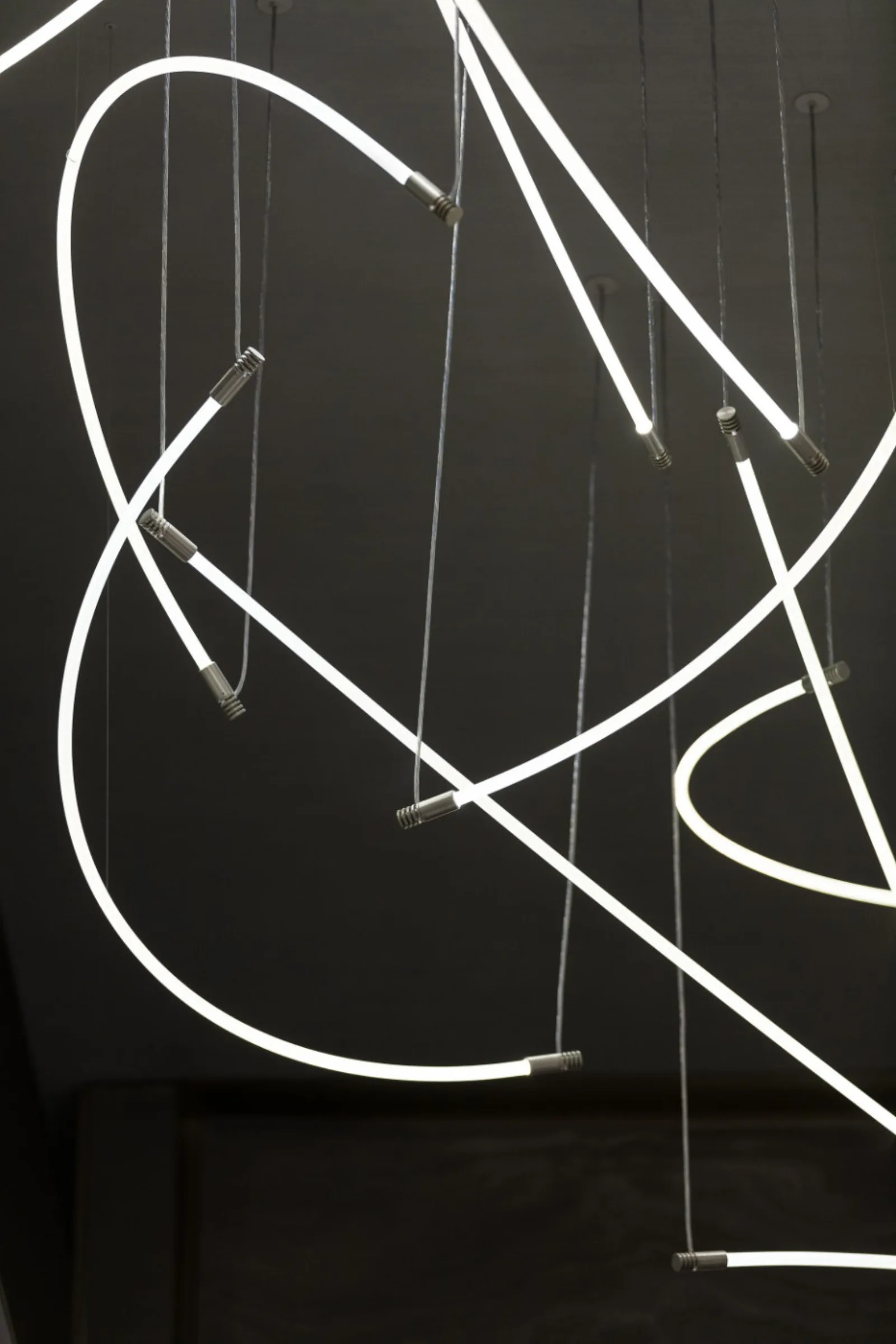
- The light is the gas itself. The glow fills the tube from wall to wall, with no individual points of light. That's the look people mean by "real neon."
- It needs high voltage. The transformer steps 120V up to thousands of volts on the secondary side. Wiring, insulators and clearances are a specialty trade.
- Every shape is hand-made. A glass bender heats the tube over a flame and bends it to a full-size pattern, letter by letter. Change the design and you make new glass.
How LED Neon Flex and LED Strip Work
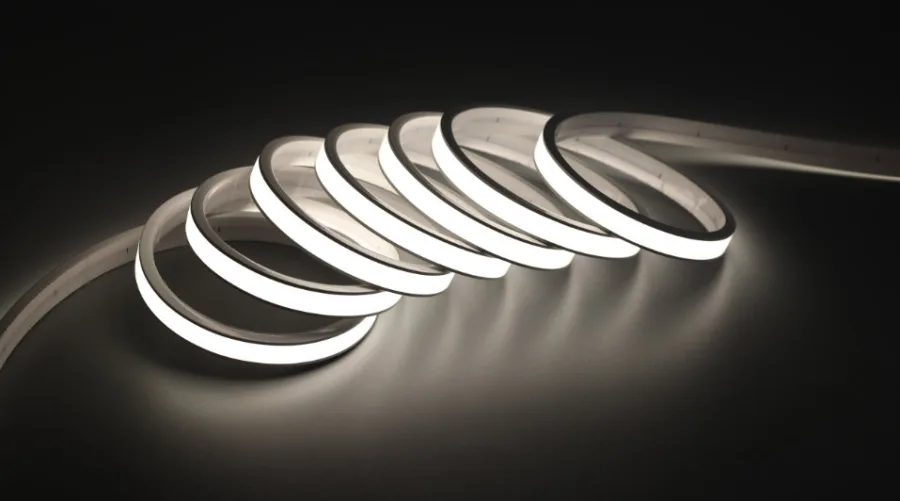
LED neon flex puts a dense row of LEDs on a flexible circuit board and encases it in a silicone or PVC jacket. The jacket is the trick: it's thick and diffusing, so the row of dots becomes one continuous line. Depending on the profile, the light comes out of the top, the side or all the way around (360°). It runs on 12V or 24V DC from an LED driver, and it bends on site by hand within its minimum bend radius. Our article on top-bend, side-bend and 360° neon explains how the profile decides which way it can bend.
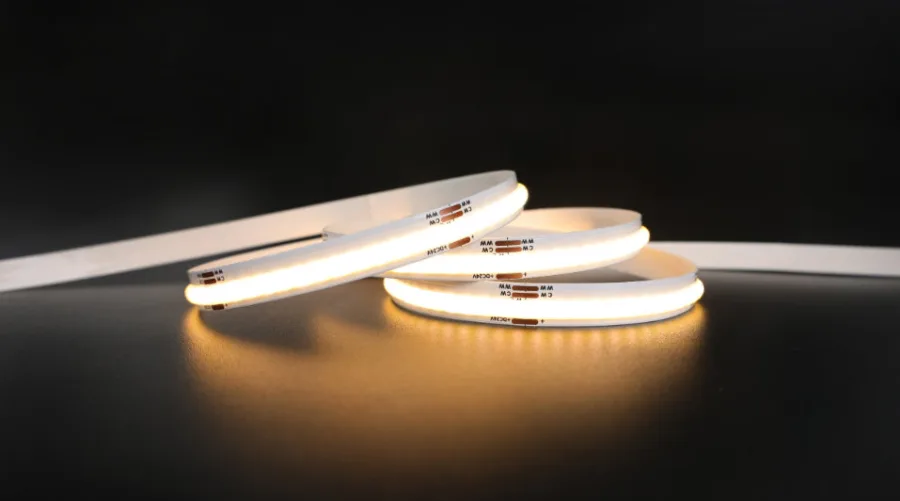
LED strip in a channel is the same kind of circuit board with no thick jacket. It mounts inside an aluminum channel with a snap-in diffuser. With a COB strip or a dense SMD strip and an opal diffuser, the line is dot-free too, but it's a flat, straight band of light in a fixed profile, not a round or rounded tube.
Side-by-Side Comparison
The table compares the three as product types. Actual output, power draw and ratings vary by product, so check each spec sheet.
| Glass neon | LED neon flex | LED strip in a channel | |
|---|---|---|---|
| Look | Glowing gas, wall-to-wall, deep color | Even line through a diffusing jacket | Even band through a flat or curved diffuser |
| Operating voltage | High voltage from a neon transformer | 12V or 24V DC | 12V or 24V DC |
| Energy use | Higher for a similar line | Lower | Lower; often the most efficient |
| Heat | Tubes and transformer run warm | Low | Low; the channel spreads heat |
| Fragility | Glass breaks; vulnerable in transport and install | Flexible, tolerates knocks | Rigid metal channel, durable |
| Bending on site | No; bent in a shop to a pattern | Yes, within the minimum bend radius | Straight runs; curves need special channel |
| Outdoor use | Common, with proper housings and wiring | Common with an IP-rated, UV-stable jacket | Needs a sealed strip and a suitable channel |
| Repair | Broken unit re-made by a glass bender | Cut out a section and splice at cut points | Replace strip or diffuser section |
| Color options | Wide range of gas, phosphor and glass colors | White CCTs, single colors, RGB, addressable | White CCTs, single colors, RGB, addressable |
| Cost of custom shapes | Rises with every bend and letter | Mostly mounting track and labor | Straight lines are cheapest; curves cost more |
Where Glass Neon Still Wins
Glass neon isn't obsolete. It still wins in a few places:
- The exact look of glowing gas. Real neon has a luminous depth, especially in the reds, and a perfectly even glow through tight bends. LED neon gets close, but someone who knows neon can tell.
- Historic restorations. A landmark sign, a vintage theater marquee or a period storefront may need real glass to stay true to the original, and preservation guidelines sometimes require it.
- Fine, tight lettering. A skilled bender can make small radii and script details that LED neon can't follow because of its minimum bend radius. LED neon letters below a certain height start to lose their shape.
- Artwork. Some artists want the medium itself, including its hum and flicker on start.
Where LED Neon Wins
For most new work, LED neon flex is the practical choice:
- Safety. 12V or 24V DC on the light side, usually from a Class 2 driver, instead of a high-voltage secondary. Fewer shock and fire concerns, and simpler wiring at the sign.
- Durability. No glass to break in shipping, on the ladder or when someone bumps it. That's why LED neon dominates in bars, retail, hospitality and anywhere people can reach the sign.
- Low voltage, low heat. Safe to mount near fabric, wood and acrylic backers, and comfortable to touch.
- Bendable on site. Shapes are made by bending the flex into a channel or mounting track, so a change of layout doesn't mean new glass. You can cut it to length at marked cut points.
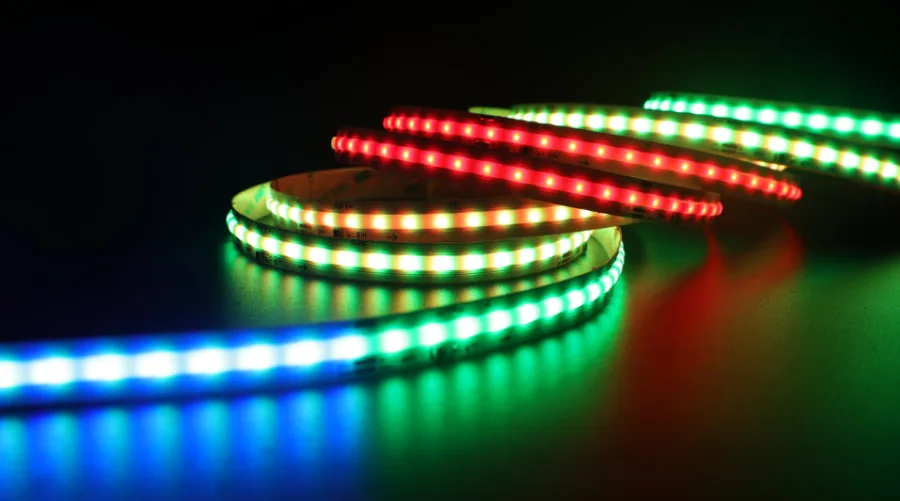
- Control. It dims with ordinary LED dimming, and there are tunable white, RGB and addressable versions. Pixel-controlled neon for chases and animations is in the addressable collection.
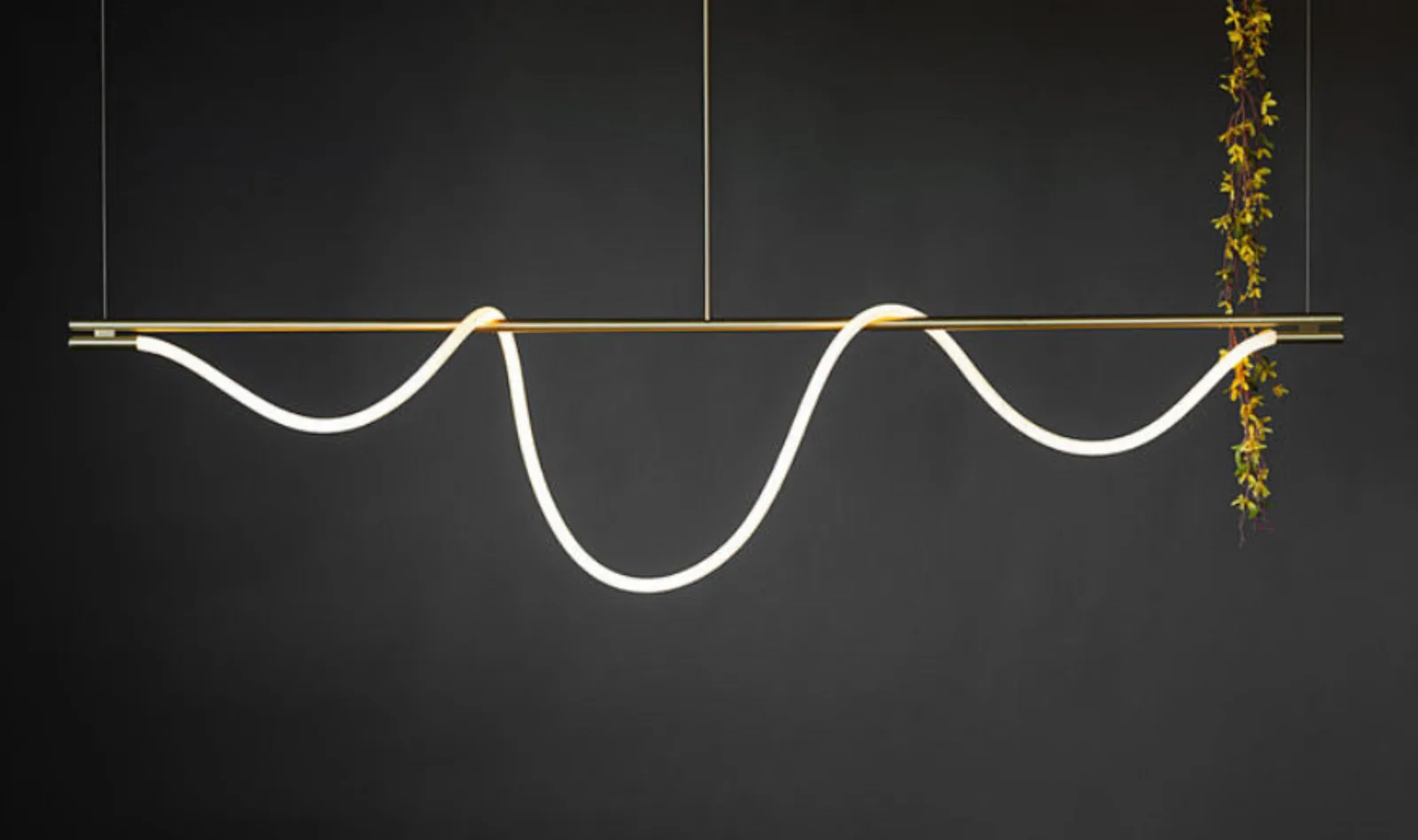
LED Neon vs LED Strip in a Channel
If the line will be straight, or the light should come from a hidden source, a strip in a channel is often better than neon flex. If the line itself is the object people look at, neon flex is the better fit.
- Glow pattern. A 360° neon flex glows all the way around, like glass. A top-bend or side-bend profile glows from one face. A strip in a channel gives one flat face of light, and the channel body stays dark.
- Dotless jacket vs diffuser. Neon flex gets its even look from the thick jacket and stays even at any viewing angle. A channel needs the right strip, diffuser and depth to hide the dots, especially when the line is visible end-on.
- Bend direction. Top-bend neon bends sideways in the plane of the wall, ideal for letters and outlines. Side-bend bends the other way, for wrapping edges and curved surfaces. A channel doesn't bend unless you buy a flexible or curved profile.
- Heat and output. An aluminum channel dissipates heat, so strip in a channel can run at higher output and usually for longer. Neon flex traps more heat in its jacket and is usually specified at moderate output.
- Service. A failed strip comes out of the channel by popping off the diffuser. Neon flex is fixed into its track or clips, so a repair means cutting and splicing at a cut point.
For signs, letters, logos and curved outlines, use neon flex. For cove, shelf, step and linear architectural lines, a channel is usually the better product, and you can see our neon flex range side by side with strip when you're deciding.
Outdoor LED Neon Signs
Outdoor neon flex lives in sun, rain and cold. A few things decide whether it lasts:
- IP rating. For signs exposed to rain, look for IP65 or higher on the spec sheet, and IP67 or IP68 where water can pool or the sign gets hosed down. The IP ratings guide explains the digits. The rating applies to the assembled run, including the ends and connections, not just the jacket.
- UV resistance. Sunlight degrades some jacket materials. Silicone generally holds up better than PVC, which can yellow and stiffen with years of UV. Check that the jacket is described as UV-resistant for outdoor use.
- Sealing the ends. Every cut is a potential leak. Use the end caps and sealing method the product specifies, fill with the specified silicone, and let it cure before the run goes outside. Keep connections out of standing water and give feed cables a drip loop.
- Driver enclosure. Mount the driver in a weatherproof enclosure or use a driver suitable for wet locations, with enough ventilation for the heat it makes.
- Codes and listing. Electric signs are covered in the NEC by Article 600, and many jurisdictions require a sign to be listed as a complete assembly and permitted before it goes up. Requirements vary by city, and some also regulate size, brightness and animation. Confirm with the local building department and a licensed sign or electrical contractor.
Worked Example: Powering a 40 ft Sign Outline
A storefront sign has a logo outline that takes 40 ft of 24V top-bend neon flex. The spec sheet lists 3 W/ft; check the real figure for your product. The drivers sit inside the building, 25 ft of cable from the sign.
- Total load: 40 ft × 3 W/ft = 120 W.
- One driver? 120 W ÷ 0.8 = 150 W minimum, so a 150 W driver. That's over the 100 VA Class 2 limit, so the output wiring follows power-circuit rules, and 120 W ÷ 24V = 5 A on one feed.
- Two Class 2 zones instead: split the outline into two 20 ft runs at cut points. Each run is 20 × 3 = 60 W, and 60 ÷ 0.8 = 75 W, so a 96 W Class 2 driver for each.
- Current per run: 60 W ÷ 24V = 2.5 A.
- Feed wire, 25 ft one way: 18 AWG: 2 × 25 × 2.5 × 0.006385 = 0.80 V, or 3.3% of 24V. 16 AWG: 2 × 25 × 2.5 × 0.004016 = 0.50 V, about 2.1%. Use 16 AWG.
- Check the max run. Neon flex often has a shorter published maximum run per feed than open strip. If 20 ft is over the limit, feed each run from both ends or split again.
On 12V, the same 120 W would draw 10 A, double the current and four times the voltage drop percentage for a given wire, which is why signs this size are almost always 24V. Run your own numbers in the power supply calculator.
Common Mistakes
- Bending past the minimum radius. Kinks crack the board inside the jacket, and that section goes dark weeks later. Check the radius on the spec sheet and use a pattern or mounting track.
- Wrong bend type for the design. Trying to form letters with side-bend neon, or wrap an edge with top-bend, twists the jacket and puts the light on the wrong face.
- Unsealed cuts outdoors. Water wicks in at a cut end within a season. Cap and seal every end the way the product requires.
- One long run from one end. Brightness drops along the run and the far end looks dim or shifts color. Feed from both ends or split the run.
- Indoor jacket outside. A non-UV-resistant jacket yellows in sun, and a low-IP build fails in rain.
- No permit or listing check. A sign that hasn't been permitted, or isn't listed as a sign assembly where required, can be ordered down after install.
- Choosing glass for an area people touch. Glass neon behind a bar or near a booth will get broken. Use LED neon where hands reach.
Frequently asked questions
Is LED neon as good as real neon?
For most signs and decor, yes: from normal viewing distance LED neon looks very similar, and it's safer, more durable and easier to shape on site. Real glass neon still has a deeper glowing-gas look that purists and historic restorations call for.
What's the difference between LED neon and LED strip?
LED neon flex is LED strip sealed in a thick diffusing jacket, so it glows as one continuous line and can be bent into shapes. LED strip in an aluminum channel gives a flat line of light from a rigid profile and usually runs cooler and brighter.
Can LED neon be used outdoors?
Yes, if the product has a suitable IP rating (IP65 or higher for rain), a UV-resistant jacket and properly sealed ends. Mount the driver in a weatherproof enclosure and check local sign rules before installing.
Does LED neon use less power than glass neon?
Generally yes. LED neon runs at 12V or 24V DC and usually draws less power for a similar line of light, and it doesn't need a high-voltage transformer. Check the watts per foot on the spec sheet to size the driver.
Can you bend LED neon flex on site?
Yes, within the minimum bend radius on its spec sheet. Top-bend neon bends in the plane of the wall for letters and outlines, side-bend bends the other way, and 360° round neon bends in any direction.
Specify with ENKORA
Working on a project? Send us the drawings and we will propose strips, profiles and drivers that fit together.